Letters Through Stories · M

The Letter M — The Mountain

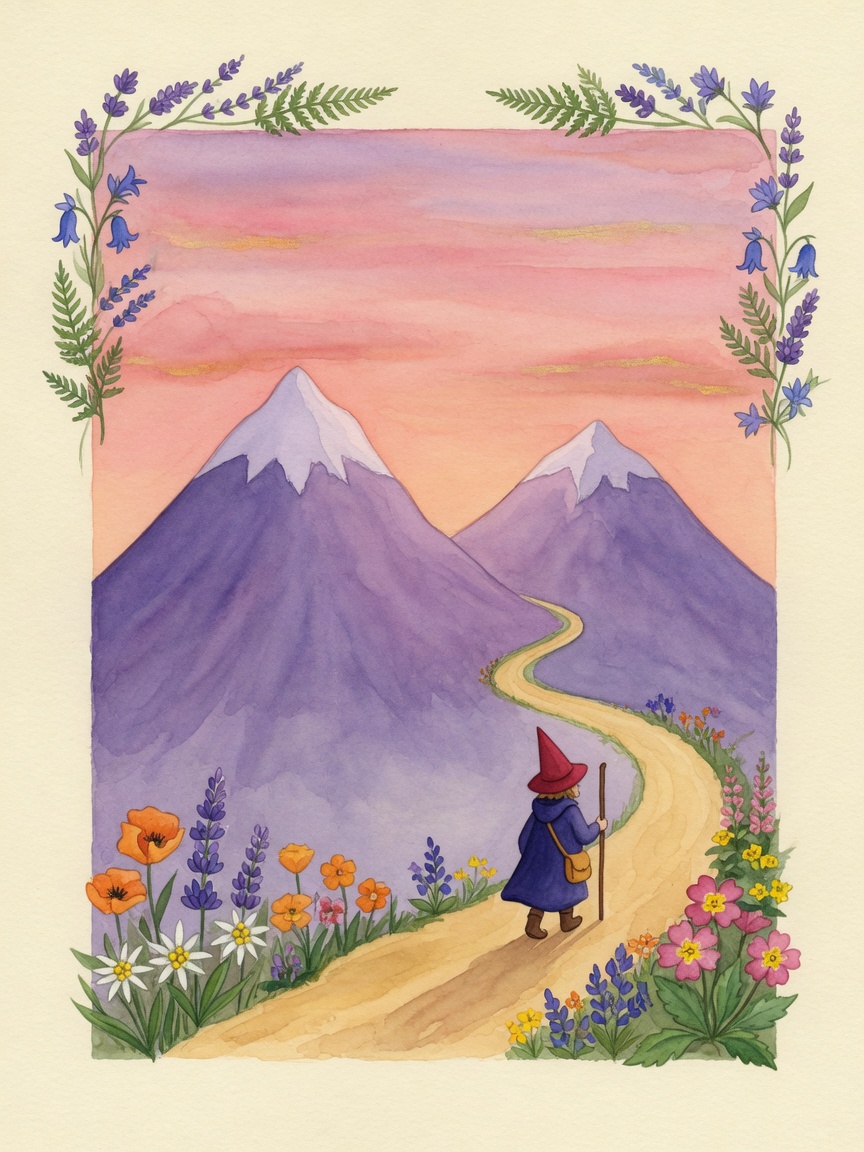
Two purple mountains against the dawn sky, and the letter M standing in their peaks.

For ages 5–7, or whenever a child begins asking about letters.

Watercolor of the mountain forming the letter M

Aim

To let the child receive the letter M the Waldorf way: first a story, then a picture, and only then the letter — discovered hiding inside the picture like a secret.

Letters taught this way arrive as friends with faces, not empty marks. The child never has to memorize what they have already met in a story.

By age

Littles (3–4): just the story and the picture. Do not point out the letter at all — it will be waiting for them in a year or two.

Olders (5–7): the full sequence: story, drawing, finding the letter, walking its shape, and writing it large.

Materials

  • Beeswax crayons or thick colored pencils
  • Large unlined paper
  • A tray of sand, salt, or cornmeal for finger-writing
  • Watercolors for the story picture

Opening Verse

Up the mountain, down I go,
Through the valley, soft and low,
Up the second, down the other —
M is Mountain, twice over!

The Story

The Wanderer and the Two Mountains.

At the edge of the world stood two great mountains, side by side, so old that they remembered when the valleys were young.

A little wanderer came walking with his stick and stood at their feet. "I want to see the sunrise country," he said, "but you are in my way."

"We are not in your way," rumbled the first mountain kindly. "We ARE the way. Climb."

So the wanderer climbed — up the first mountain, higher and higher, until he stood on the very peak with the wind in his hair. Then down into the little valley between, where a spring gave him water. Then up the second mountain, step by step by step, and down its far side into the golden morning.

When he was an old man he drew the journey for his grandchildren with one line: up, down into the valley, up again, and down — and the grandchildren said, "Grandfather, you have drawn a letter!"

"No," said the old wanderer, smiling. "I have drawn two mountains. The letter came to live in them later, the way I once did."

The Discovery

The day after the story, draw the picture together, big and beautiful — and then the magic: trace the the mountain slowly with your finger and say, Look — there is a letter hiding in our picture!

Let the child find the M shape inside the drawing themselves if they can. A letter a child discovers belongs to them forever.

The letter is the wanderer’s own path: up-down-up-down over two peaks. Draw the two purple mountains side by side and the M stands in their skyline.

Movement

Walk the letter: lay a rope or ribbon on the floor in the shape of the great M and walk it heel-to-toe, both directions, saying its sound.

Then write it in the air with a whole arm, in the sand tray with one finger, and on each other’s backs to guess.

Writing Work

Now the crayon: write the M very large on unlined paper — once beautifully is worth more than a row of twenty. Then the child hunts the letter like a hidden bird: mountain, moon, mama, milk, mouse, meadow, morning — M begins the warmest words we know.

End by hanging the story picture with its letter on the wall. The alphabet grows along the wall through the year, picture by picture.

Spiritual Meaning

For the parent:

Humanity drew pictures long before it wrote letters — and every child recapitulates that journey. Meeting letters through images honors the way the young mind actually works: whole, pictorial, and story-shaped first.

For the child, keep it simple:

Every letter was once a picture. M still remembers being the mountain.

Closing Blessing

Thank you, mountains, old and tall,
You taught the wanderer, teach us all:
The way is up and down and through —
And M will always stand for you.

Extension Ideas

  • Find the M on signs and packages all week — greet it like a friend.
  • Model the letter in beeswax or bread dough.
  • Tell the story again at bedtime and let the child finish the sentences.
  • Move to the next letter only when this one is loved: one letter a week is plenty.

Parent Note

Consonants come first in Waldorf letter work because they are picture-like; vowels come later as feelings and sounds. And there is no race: a letter met deeply at six outruns twenty-six memorized anxiously at four.