Nature Science · Light & Color · Ages 3–6

Where Rain and Sun Meet

A living rainbow lesson through story, observation, light, water, movement, painting, and wonder.

A rainbow appears when sunlight and water meet in exactly the right way.

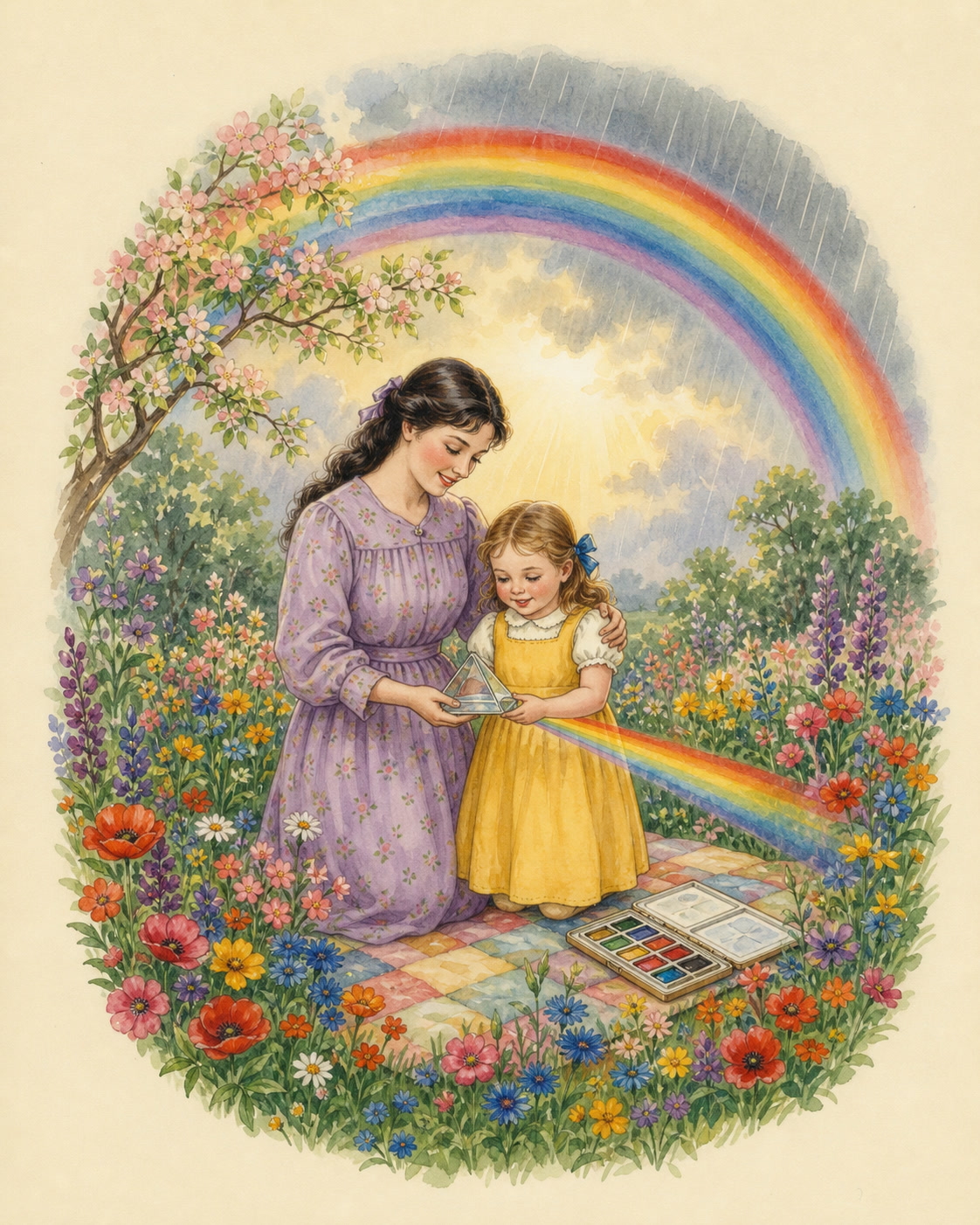
Watercolor of a mother and child watching a rainbow after rain, with a prism and watercolor box

Opening Verse

Rain is falling, Sun shines through,
Red and orange, green and blue.
Light bends softly, colors show—
Across the sky, a shining bow.

The Living Story

The Drop That Opened the Light

A small raindrop rested high in the air after the storm. Sunlight came traveling toward it, bright and white. But white light was carrying many colors together.

When the light entered the raindrop, it slowed and bent. Inside, it reflected from the back of the drop. As it left, it bent once more—and the colors spread apart.

Red opened along the outside of the bow. Then came orange, yellow, green, blue, indigo, and violet.

Thousands upon thousands of drops did the same thing at once. The child stood with the Sun behind her and rain ahead. There, opposite the Sun, the hidden colors became visible across the sky.

Discover through doing

Three Ways to Find the Colors

Discovery 1

Prism on the Wall

Use a prism or faceted crystal to separate white sunlight into colors.

Open the activity

Gather

A glass prism or clear faceted crystal, direct sunlight, and a white wall or sheet of paper.

Try

  1. Darken the room slightly while allowing one narrow beam of sunlight.
  2. Adult holds and slowly turns the prism in the beam.
  3. Look for a band of colors on the wall or paper.
  4. Move the prism closer and farther. Notice what changes.

Say simply: The prism bends each color by a slightly different amount, so the colors spread apart.

Safety: Never look directly at the Sun through a prism or any optical object.

Discovery 2

Water-and-Mirror Rainbow

A shallow dish of water and a mirror can send a small spectrum onto white paper.

Open the activity

Gather

A shallow clear dish, water, a small mirror, white paper, and direct sunlight.

Try

  1. Place the mirror partly under water at an angle.
  2. Let sunlight strike the submerged part of the mirror.
  3. Hold white paper where the reflected light lands.
  4. Adjust the mirror slowly until colors appear.

Adult handles the mirror and glass. Never direct reflected sunlight toward anyone’s eyes.

Discovery 3

A Rainbow in Garden Mist

Make fine droplets outdoors and place yourself in the correct relationship to the Sun.

Open the activity
  1. Choose a sunny time and stand with the Sun behind you.
  2. Adult sprays a garden hose into a fine mist ahead, away from faces.
  3. Look into the mist opposite the Sun.
  4. Move slightly until the bow appears.

Ask: Where is the Sun? Where is the water? Where did the rainbow appear?

Use a gentle mist on non-slippery ground, away from electricity and roads.

Look Closely

Rainbow, Reflection, or Colored Light?

Compare what made each color appear.

Open the comparison
  • Rainbow: sunlight is bent, reflected, and spread by many water droplets.
  • Spectrum: a prism or water-and-mirror setup separates white light into colors.
  • Reflection: light bounces from a shiny surface; it does not always separate into colors.
  • Painted colors: pigments absorb and reflect parts of light. Mixing paint differs from mixing beams of light.

The Color Path

Red to Violet

In a primary rainbow, the visible order from the outside edge inward is:

Red, orange, yellow, green,
Blue, indigo, violet seen.

Lay seven colored silks, ribbons, crayons, flowers, or household objects in order. Close the child’s eyes, remove one, and ask which color is missing.

The bands blend rather than forming hard stripes. The seven-name sequence is a useful traditional map of a continuous spectrum.

Movement

Become the Bow

  1. Curl low as rain gathers.
  2. Rise tall as the Sun comes out.
  3. Travel straight like a beam of white light.
  4. Bend slowly as light enters a drop.
  5. Turn once as it reflects inside.
  6. Open both arms wide as the colors spread across the sky.

Lay seven silks in a bow on the floor and travel the curve from red to violet.

Watercolor

Paint Light, Not Stripes

Wet the paper evenly. Begin with a soft arc of red near the outer edge, then allow orange and yellow to touch gently. Continue through green, blue, and violet, using clear water when needed.

Do not outline the bow in black. Let the edges soften into the sky, because a real rainbow is made of light and has no hard border.

For a younger child, use three broad color families—warm red/yellow, green, and cool blue/violet—and let the full sequence grow over repeated paintings.

Practical Life

Gather a Rainbow Table

Choose one food from as many color families as the household already has: strawberries or tomato; orange or carrot; banana or corn; peas or cucumber; blueberries; purple cabbage, grapes, or plum.

  1. Wash produce together.
  2. Sort it by color.
  3. Name texture, scent, shape, and taste.
  4. Arrange the foods from red toward violet.
  5. Eat the rainbow together.

No purchase is required. Use what is present, and cut choking-risk foods into age-appropriate shapes.

Closing Verse

The rain has passed, the light shines through,
And opens every hidden hue.
I watched the sky; I came to know:
Sun, drops, and sight reveal the bow.

← Return to Weather Watchers