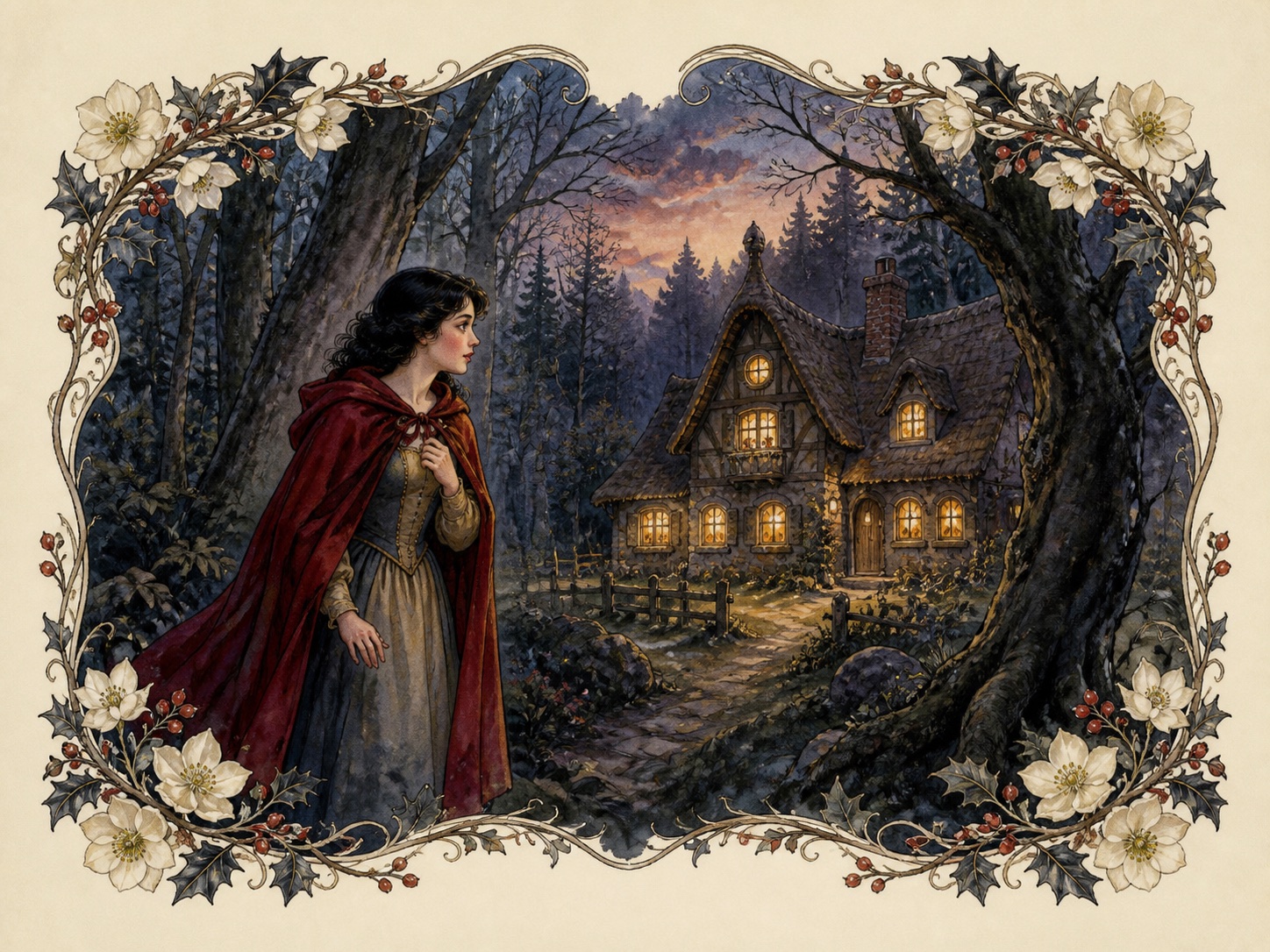
Long ago, in the middle of winter, when snowflakes fell like feathers from the sky, a queen sat sewing at a window whose frame was made of ebony wood. She pricked her finger with the needle, and three drops of blood fell upon the snow. Against the white and the black frame the red looked so beautiful that the queen said, “If only I had a child as white as snow, as red as blood, and as black as the wood of this window.” Soon afterward she gave birth to a little daughter whose skin was white as snow, whose lips were red as blood, and whose hair was black as ebony. They called her Snow White. The queen was filled with joy, yet before the child had lived a year, the queen fell ill and died.
After a time of mourning the king took another wife. She was a beautiful woman, proud of her looks and skilled with spells, and she owned a magic mirror that answered any question put to it. Each morning she stood before the glass and asked, “Mirror, mirror on the wall, who in this land is fairest of all?” and the mirror always answered, “You, O Queen, are the fairest of all.” The new queen was content, for she believed the mirror spoke only truth.
Years passed, and Snow White grew from a child into a girl whose beauty shone brighter each season. One morning the queen asked her usual question, but the mirror replied, “Queen, you are fair, it is true, but Snow White is fairer far than you.” The queen’s face grew pale with anger and fear. From that day her heart turned against the girl, and she could not rest until she had rid herself of the rival she now saw in her own house.
At last the queen called a huntsman and ordered him to take Snow White deep into the forest, to kill her, and to bring back her lungs and liver as proof. The huntsman led the girl among the tall pines until they reached a lonely glade. Snow White noticed his hands trembling and asked why he looked so troubled. When he confessed the queen’s command, she wept and begged for her life, promising to run away and never return. Moved by her sorrow, the huntsman spared her, killed a young boar instead, and carried its lungs and liver to the palace. The queen ordered them cooked and ate them with salt, believing she had devoured her enemy’s heart.
Alone in the darkening wood, Snow White walked until the trees thinned and she saw seven little lights shining through the dusk. She came upon a cottage whose roof was thatched with straw and whose seven small chairs stood around a scrubbed table. Inside she found seven little beds, each neatly made. Tired and hungry, she tasted a bit of porridge from each bowl and lay down across all seven beds to rest. When the owners returned, they were seven dwarfs who worked each day mining gold and silver in the nearby hills.
By the light of their lantern the dwarfs discovered the sleeping girl. They whispered among themselves, marveling at her beauty and wondering who she might be. When Snow White awoke and told them her story, the kindhearted dwarfs offered her shelter if she would keep house for them while they were away at the mines. She agreed gladly, promising to cook, wash, and keep the cottage tidy. Each morning the dwarfs marched off with their picks and lanterns, and each evening they returned to find supper ready and the rooms swept clean.
Meanwhile the queen returned to her mirror and asked once more who was fairest. The glass answered that Snow White still lived and was fairest of all. Furious, the queen understood that the huntsman had betrayed her. She decided to act with her own hands and brewed a powerful poison. Disguising herself as an old peddler woman with a basket of bright laces, she set out for the dwarfs’ cottage.
When the peddler knocked at the door, Snow White opened it and admired the colorful laces. The old woman offered to lace her properly, and Snow White, trusting the kind voice, let the woman pull the stays tight. The laces were enchanted; they tightened until Snow White could no longer breathe and fell as though dead. The peddler hurried away, certain her rival was finished. That evening the dwarfs found Snow White lying still on the floor. They cut the cruel laces, and she drew a deep breath and opened her eyes. They warned her never again to open the door to strangers.
The queen learned from her mirror that Snow White lived still, so she fashioned a poisoned comb, painted it with deadly colors, and returned in another disguise. She offered to comb the girl’s long black hair. As soon as the comb touched Snow White’s head, the poison worked and she dropped senseless. The dwarfs came home to find her lifeless once more, but they recognized the wicked comb, drew it out, and revived her. Again they begged her to guard against strangers.
A third time the mirror gave its unwelcome answer. The queen prepared a rosy-cheeked apple, one half harmless and the other steeped in poison. Dressed as a farmer’s wife, she appeared at the cottage with a basket of fruit. Snow White hesitated at the door, remembering the dwarfs’ warnings, yet the apple looked so fresh and the woman spoke so gently that at last she accepted a bite from the poisoned half. She fell to the floor at once, and this time she did not stir.
When the dwarfs returned they could not wake her. They tried every remedy they knew, but her cheeks remained pale and her breath was gone. Heartbroken, they laid her in a glass coffin so they might always see her lovely face. They wrote her name in golden letters on the lid and set the coffin upon a hillside where wildflowers grew. A white bird came each day to perch on the coffin and sing.
One day a prince rode through the forest and saw the shining coffin. He read the golden words and felt such sorrow that he asked the dwarfs to let him carry the coffin to his castle. At first they refused, but when he promised to honor her always, they consented. As the servants lifted the coffin, one of them stumbled on a root. The jolt shook the poisoned piece of apple from Snow White’s throat. Color returned to her cheeks; she opened her eyes and sat up, alive once more.
The prince and Snow White looked at each other and knew at once that their hearts were joined. He asked her to come with him to his kingdom, and she agreed. Before they left, Snow White thanked the seven dwarfs for their kindness and promised she would never forget them. The dwarfs waved until the royal carriage disappeared among the trees.
News of the wedding reached the queen’s palace. Curious and uneasy, she dressed in her finest gown and traveled to the feast. When she entered the great hall she saw the bride and recognized Snow White at once. Rage and terror seized her, yet she forced herself to smile and accept a goblet of wine. At the end of the meal, iron slippers heated until they glowed red were brought before her. She was forced to dance in them until she fell and moved no more.
Snow White and the prince ruled wisely and kindly. The seven dwarfs visited often, bringing gifts of gold and silver from their mines. The old mirror, now silent, was stored away where no one asked it questions. In the castle garden a tree with white blossoms, blood-red fruit, and dark bark grew beside a window whose frame was carved of ebony, and every winter its branches reminded the queen of the wish once spoken at another window long ago.
On quiet evenings Snow White told the prince and their children the story of the ebony window, the three drops of blood, and the little cottage in the wood. The children listened with wide eyes, and when the tale reached the glass coffin they always asked whether the bird still sang upon the lid. Snow White would smile and say the bird had found a new branch, but its song remained the same.
The seven dwarfs kept the cottage just as Snow White had left it. Each spring they planted snowdrops beneath the window boxes, and each autumn they polished the seven little chairs until the wood gleamed. Travelers passing by sometimes heard seven hammers ringing in the hills and knew the miners still guarded their memories of the girl who had once kept their house.
In the queen’s abandoned chamber the mirror gathered dust. Servants whispered that on certain nights a faint voice could be heard asking who was fairest, yet no answer ever came. The silence itself became a warning that pride and envy lead only to sorrow.
Snow White’s kindness became as famous as her beauty. She sent food to families whose harvests failed and opened the castle gates so that wandering musicians could play in the courtyards. People said the kingdom flourished because its queen remembered what it felt like to be lost in a dark wood and found by friends.
Every year on the anniversary of her awakening, Snow White and the prince walked to the hillside where the glass coffin had stood. They brought wreaths of white roses and red berries. The seven dwarfs met them there, and together they remembered the day the poisoned apple fell away and life began again.
The children grew tall and strong. The oldest daughter had hair black as ebony, the middle son had cheeks red as blood, and the youngest girl’s skin was fair as snow. When they asked their mother how she had stayed brave, Snow White answered that she had never been alone; the forest, the cottage, and the stars above the coffin had all kept watch with her.
In time the story traveled beyond the kingdom. Woodcutters told it beside their fires, and mothers repeated it while rocking cradles. Each listener added a small detail—a brighter bird, a deeper shadow—but the heart of the tale remained unchanged: a wish spoken at a window, a heart turned cold by envy, and a life restored by faithful friends.
The prince’s castle stood on a hill overlooking a river that ran clear in summer and frozen in winter. Snow White often walked along its banks with her children, pointing out places where deer came to drink and where the first snowdrops appeared through melting ice. She taught them the names of trees and the habits of birds, so that the forest would never feel like a stranger to them.
On stormy nights when wind rattled the shutters, the family gathered in the great hall. Snow White would light a single candle and begin the story once more, her voice calm and steady. The children leaned forward, knowing every turn yet still holding their breath when the peddler offered the apple. The candle flame flickered like a tiny heart, and the room felt safe because the danger lived only in words.
Years later, when Snow White’s hair carried threads of silver, she still kept the little mirror the dwarfs had given her on the day she left the cottage. It was plain silver without magic, yet whenever she looked into it she remembered the girl who had trusted too quickly and the friends who had taught her caution without taking away her trust in goodness.
The kingdom’s historians recorded that Snow White reigned for many peaceful decades. They wrote of the seven miners who dined at the royal table each spring and of the glass coffin preserved in a quiet chapel where visitors came to see the place where a queen had slept and wakened. The pages of the chronicle grew dusty, but the story itself never did.
And so the tale returns to its beginning: a window, three drops of blood, and a wish that shaped a life. Those who hear it understand that beauty can awaken envy, that envy can darken a heart, and that hearts can be mended by loyalty, courage, and the simple kindness of seven small chairs set around a table for supper.