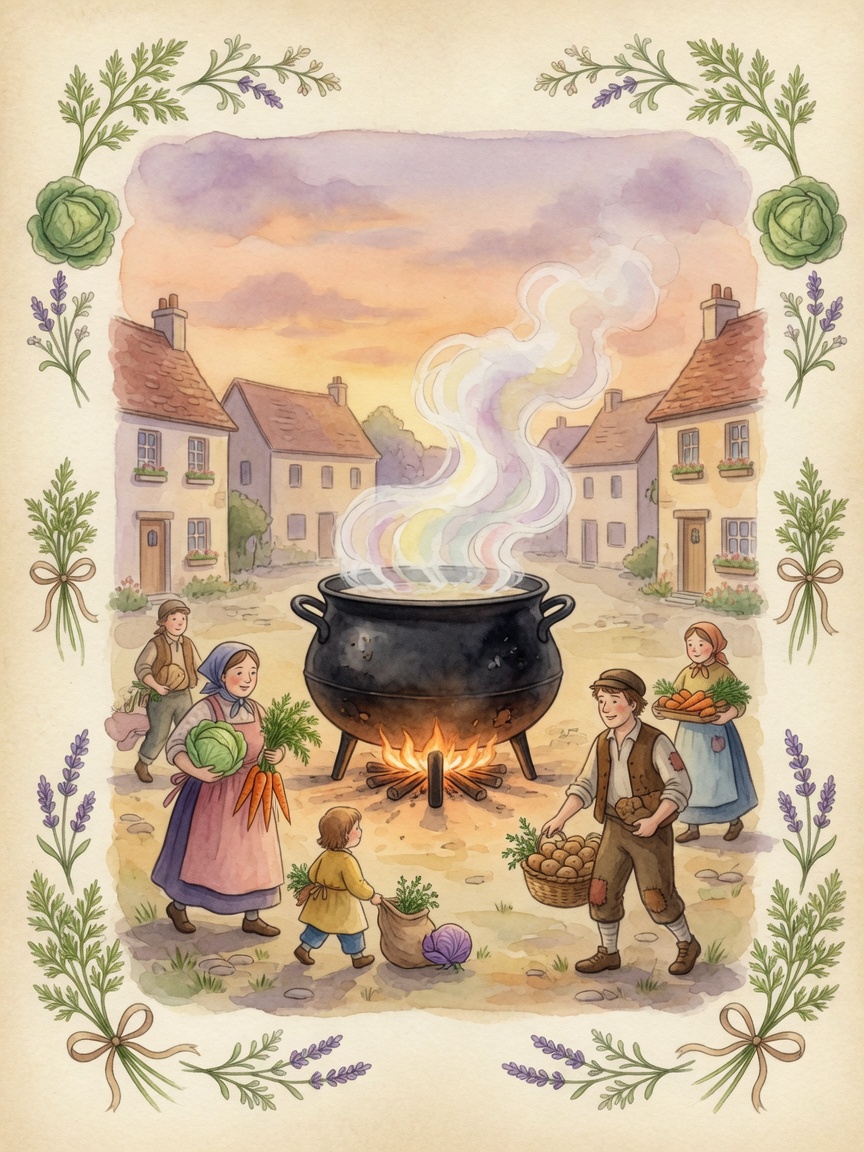
The soldier had learned long ago that hunger made people careful and that careful people kept their stores hidden. He did not blame them. He had seen villages stripped by armies and by bad weather, and he knew the look of empty bins and worried mothers. Still, the road was long, and he needed a hot meal and a roof for the night. He washed his hands at the well and considered what he might do with the single stone he carried in his pocket, a smooth gray river stone he had picked up weeks before for no reason he could name.
Children appeared first, drawn by the sight of a stranger. They stood at a cautious distance, whispering behind their hands. One small girl carried a bucket too heavy for her, and water slopped over the rim with each step. The soldier offered to carry it the last few yards to her door. She hesitated, then nodded, and together they walked past the watching windows. When they reached the step, her mother opened the door just wide enough to take the bucket and pull the child inside. The door closed without a word spoken to the man.
He returned to the square and sat on the low stone wall. The air smelled of woodsmoke and damp earth. Somewhere a dog barked once and fell silent. The soldier took the gray stone from his pocket and turned it over in his hands, feeling its cool weight. He had an idea that depended on curiosity more than kindness, and he knew he would have to be patient. He set the stone on the wall where anyone passing could see it and waited.
An old man came out to fetch water. He glanced at the soldier, then at the stone, then back again. 'What is that you have there?' he asked at last. The soldier answered that it was a stone for making soup, nothing more. The old man frowned and said he had never heard of such a thing. The soldier replied that it was a soldier’s trick, learned in a far country where food was scarce. He did not explain further. The old man carried his bucket home and closed his door, but the soldier noticed that he left it unlatched.
Soon the widow who lived nearest the well came out with her shawl pulled tight. She had seen the old man speaking and wanted to know what news there was. The soldier told her the same thing: he could make soup from a stone. She asked what sort of stone, and he showed her the smooth gray one. She touched it with one finger and said it did not look special. The soldier agreed that it did not, yet promised that with fire and water it would feed many. The widow looked at her own thin arms and at the children watching from doorways and said nothing more.
By now the light had gone and lamps were lit inside the cottages. The soldier gathered twigs and dry leaves and built a small careful fire in the open square. He set a battered pot he carried on the flames and poured water from the well into it. When the water began to steam, he dropped the stone in with a small sound that carried in the quiet air. Several faces appeared at windows again. The soldier stirred the pot with a stick and hummed a tune he had learned on another road.
The widow’s door opened a little wider. She stepped out holding a wooden bowl. 'If it is truly soup,' she said, 'it will need salt.' She poured a handful into the pot and stepped back. The soldier thanked her and kept stirring. The smell of salt and hot water rose with the steam. A boy came next, carrying a single pale onion. He said his mother had sent it because the soup would be thin without something to give it taste. The soldier accepted the onion, peeled it with his knife, and added the pieces to the water.
Two more children appeared with a handful of carrots, muddy from the garden. They dropped them in without speaking and ran back to their mothers. The soldier cut the carrots into thick coins and let them sink. The pot began to bubble in earnest. A man who had been mending a cart wheel brought a small bone saved from a Sunday roast. He dropped it in and wiped his hands on his apron. 'Bones give strength,' he said. The soldier nodded and moved the bone with the stick so it would not stick to the bottom.
The widow returned with a few potatoes, their eyes already sprouting. She cut them at her own doorstep and brought the pieces in her apron. 'They were meant for planting,' she said, 'but the winter has been long.' The soldier added them carefully, thanking her each time. The fire crackled and the water darkened. Someone brought a few cabbage leaves, torn and already yellow at the edges. They floated on the surface and slowly sank. The square began to fill with the smell of cooking vegetables and salt.
A girl no older than eight arrived with a wooden spoon her grandmother had carved. She said the spoon was for stirring, not for keeping. The soldier took it with both hands and used it at once, letting the girl watch the motion. She stood close enough now to feel the heat from the pot. Her mother came to fetch her but stayed when she saw the steam rising in steady clouds. The mother had a small twist of dried herbs in her pocket. She untied it and let the leaves fall into the soup.
The old man reappeared with a piece of hard cheese wrapped in cloth. He said it was the last bit and that he had planned to grate it over his own supper, but the smell from the square had changed his mind. The soldier accepted the cheese and set it on a flat stone near the fire so it would soften. He did not promise anything in return. The old man sat on the wall and watched the bubbles rise and break.
More neighbors came, each with something small: a few dried peas, a heel of bread, a cup of milk still warm from the evening milking. They placed their offerings on the wall and stepped back, waiting to see what would happen. The soldier accepted each gift without surprise and added it to the pot in turn. The soup grew thicker. The fire needed feeding, and someone brought an armload of split wood without being asked. The wood caught quickly and burned with a steady light that pushed the darkness back to the edges of the square.
A man who had lost most of his harvest to rain brought three small turnips. He said they were hardly worth eating, but they might help. The soldier thanked him and quartered the turnips with his knife, dropping the pieces into the pot one by one. The turnips bobbed and then sank. The man stayed to watch them disappear. He asked quietly whether the stone truly had any power. The soldier answered that the stone had the power to bring people to the same fire, and that was enough for one night.
The widow’s daughter returned with a bowl of barley she had been saving for the chickens. She poured it slowly so none would spill. The grains clouded the water and then settled. The soup now smelled of grain and root and salt. The girl asked if the stone would still be good after the soup was eaten. The soldier said it would need only to be washed and dried and kept in a pocket for the next time it was needed. The girl considered this and nodded as if the answer made sense.
A boy who had been told to stay inside disobeyed and brought a handful of mushrooms he had gathered that afternoon. His mother followed him, scolding, but stopped when she saw how many people were already gathered. She looked at the pot and at the stone resting on the rim and said nothing. The soldier sliced the mushrooms thin and added them last so they would not cook away completely. The boy was allowed to stay and hold the spoon for a while.
The fire had burned down to steady coals that gave more heat than light. The soup simmered with a low sound that filled the pauses between voices. People began to bring bowls and spoons from their own kitchens. They set them on the wall in a line. No one asked whether there would be enough. The soldier kept stirring, tasting now and then with the carved spoon, adding a pinch of salt when it was needed and nothing when it was not.
The old man rose and fetched a bench from his doorway. He placed it near the fire and motioned for the children to sit. They came slowly at first, then faster when they saw there was room. Their mothers followed with shawls to wrap around small shoulders. The square grew warmer with the press of bodies and the steady heat from the coals. Someone began to hum the same tune the soldier had hummed earlier, and others joined without being asked.
The widow ladled the first bowl. She gave it to the soldier. He took it with both hands and waited until everyone else had been served before he lifted it to his mouth. The soup was thick enough to coat the spoon and thin enough to drink. It tasted of onion and salt and the faint sweetness of carrot. He ate slowly, letting the warmth spread through his chest and arms. Around him, people ate without speaking for several minutes.
When the bowls were empty, the soldier lifted the stone from the pot with the carved spoon and set it on the wall to cool. He rinsed the pot with a little water from the well and set it aside. The children watched the stone as if it might still do something surprising. It sat gray and ordinary under the lamplight. The widow wrapped it in a cloth and gave it back to the soldier. He thanked her and put it in his pocket where it had been before.
People began to drift back to their doors, carrying their bowls and spoons. Some stopped to speak with the soldier. They asked where he had learned to make stone soup. He answered that every village had its own way, but the stone was the same in all of them. A few offered him a place by their fire for the night. He chose the widow’s house because it was nearest the well and because she had been the first to bring salt.
Before he went inside, the soldier walked once more around the square. The fire had been damped with earth and the pot had been scoured with sand. The stone was safe in his pocket, smooth and cool again. He could feel the weight of it against his leg as he walked. The night was colder now, and the stars showed between the clouds. He could hear the low voices of families settling for sleep behind their doors.
In the morning the widow gave him bread and cheese wrapped in a cloth. She did not ask him to stay, and he did not offer to. He shouldered his pack and walked to the edge of the village where the road climbed toward the next ridge. The children followed him part of the way, then turned back when their mothers called. He waved once without looking behind him and kept walking.
The stone remained in his pocket, ready for the next village and the next evening when doors might be closed. He did not think of it as magic. He thought of it as a reminder that hunger could be met with patience and that patience sometimes needed a visible reason before people would act. The road was long, but the weight in his pocket was light, and the morning was clear.
Behind him the village returned to its usual work. Carts rolled out to the fields again, and smoke rose from the chimneys at midday. The well bucket creaked on its rope. The widow swept her step and kept the carved spoon on the table where she could see it. The children played the same games they had played before the soldier came, but sometimes they paused to look at the place in the square where the fire had been.
No one spoke of the soup as a miracle. They spoke of it as a meal that had happened when there was almost nothing left to share. The old man told his grandchildren that stones did not make soup by themselves, but people sometimes needed a reason to open their doors. The widow agreed without saying the words aloud. The village kept its caution, but it also kept the memory of one evening when the square had been warm and the pot had been full.
The soldier walked until the village was out of sight behind the trees. He stopped at a stream to drink and to wash the dust from his hands. The stone clicked against the other small things in his pocket. He took it out, looked at it once in the sunlight, and put it back. Then he continued along the road, watching the horizon for the next line of smoke that would tell him where people lived and whether their doors would open before night fell again.