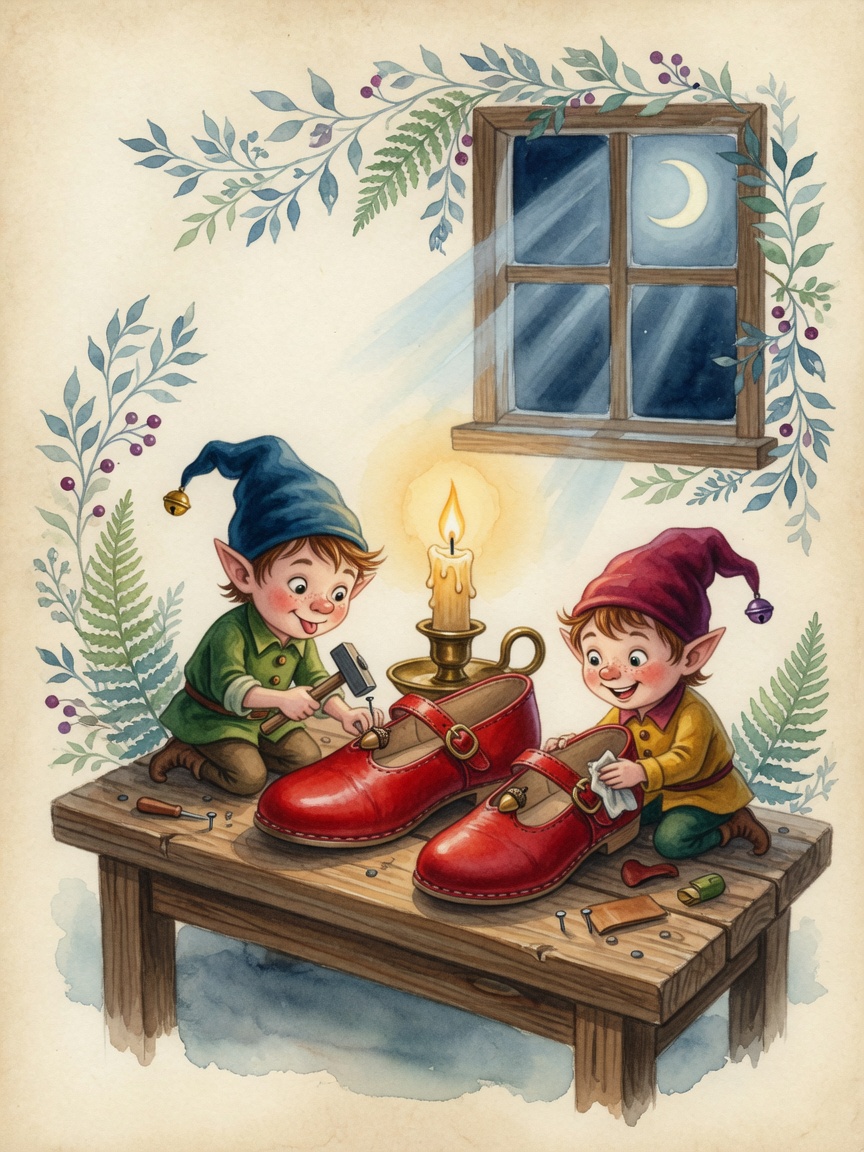
There was once an honest shoemaker who lived with his wife above a narrow shop. He had always worked carefully, choosing sound leather, pulling every stitch straight, and making shoes that lasted. But a hard season came. Customers had little money, the price of leather rose, and one by one the coins disappeared from the jar on the mantel.
At last, after paying what he owed, the shoemaker had only enough leather left for one pair of shoes. That evening he measured it twice and cut the pieces with his sharpest knife. His hands were tired, and the candle had burned low, so he laid the pieces in order on his bench. “I will stitch them at first light,” he told his wife.
They shared their last crust of bread, banked the small fire, and climbed the stairs. The shoemaker was troubled, for if this pair did not sell, he could buy no more leather. Still, he said his prayers and slept. Below them the workshop stood silent in the moonlight, with the cut pieces waiting beside the awl and waxed thread.
The next morning when the shoemaker came down to his workshop, he stopped in the doorway and stared. There on the bench stood a pair of shoes finished to the last stitch, the leather shaped and smoothed, the seams straight and strong, as though a master had worked through the night.
He lifted one shoe and turned it in the early light. The stitches were small and even, the soles firm, the uppers without a wrinkle. He called his wife, and together they examined the shoes, turning them this way and that, unable to find a single fault.
A customer entered before noon, tried the shoes on, and paid a good price without bargaining. With the money the shoemaker bought leather for two pairs and cut the pieces that same evening, laying them ready before he and his wife went to bed.
In the morning two pairs of finished shoes stood on the bench. The leather had been cut and sewn with the same quiet skill, and when customers came they paid willingly, leaving the shoemaker enough coin to buy leather for four pairs.
Each night the shoemaker cut the leather and left it on the bench. Each morning the work was done, and the shoes were finer than any he had made with his own hands. Word spread through the town that the shoemaker’s shoes never wore out at the seams and never pinched at the toes.
Soon the bench was covered with new leather every evening, and every morning the shoes stood ready. The shoemaker’s purse grew heavier, his table had bread and meat again, and his wife began to wonder who could be doing such work without payment or thanks.
One winter evening, after the leather had been cut and the fire banked low, the shoemaker said to his wife, 'Let us stay awake and see who comes to help us.' They hid behind a curtain that hid the corner of the room and kept very still.
When the clock struck midnight, the door opened without a sound. Two small figures slipped inside, no taller than the shoemaker’s forearm, their clothes ragged and their feet bare. They climbed onto the bench and began to work at once.
Tiny fingers pulled thread through leather, hammers tapped soles into place, and needles flashed in the firelight. The little men did not speak, yet their movements were quick and sure, and by the time the first light touched the window they had finished every pair and vanished as quietly as they had come.
The shoemaker and his wife looked at each other in the gray dawn. 'Those poor little creatures,' the wife said. 'They had no coats against the cold, and their feet were bare on the cold floor.' The shoemaker nodded and said nothing for a long moment.
The next day the wife bought the softest cloth she could afford and cut two small shirts, two pairs of trousers, and two little coats. The shoemaker cut and stitched two pairs of tiny shoes from the finest scraps of leather, working slowly so that every seam would be comfortable.
When night came they laid the clothes and shoes on the bench instead of leather, then hid once more behind the curtain. At midnight the little men returned. They stared at the neat piles, touched the cloth, and tried on the shoes with small sounds of wonder.
In a moment they were dressed. The coats sat neatly on their shoulders, the shoes fit without pinching, and the new clothes made them stand taller. They turned once in the firelight, laughed without making a sound, and danced out through the door into the snowy street.
After that night no more finished shoes appeared on the bench. The shoemaker cut leather again with his own hands, and though the work went more slowly, customers still came because the shoes were well made and fairly priced.
One afternoon a richly dressed man entered the shop and asked for boots that would last a long journey. The shoemaker measured his feet and promised the boots for the following week. That evening he cut the leather with special care and left it on the bench.
In the morning the boots stood finished, but the shoemaker knew he had not sewn them. He carried them to the rich man, who paid twice the asking price and ordered two more pairs. The shoemaker bought more leather and began to cut again, wondering whether the little men would return.
Weeks passed and the bench remained empty each morning. The shoemaker and his wife kept the little clothes they had made and sometimes wondered where the helpers had gone and whether they were warm.
One spring evening a traveler stopped at the shop and told of two small figures seen dancing in the forest at dusk, their coats bright and their shoes gleaming. The shoemaker listened and said nothing, but that night he left a candle burning low and a crust of bread on the windowsill.
No one came to the window, yet the next morning two pairs of shoes stood on the bench again. They were smaller than any the shoemaker had made before, as though made for children, and the stitching was the finest he had ever seen.
From that time on the shoemaker found that whenever he cut leather and left it overnight, the work was finished by morning. He never again tried to watch, and he never again left clothes on the bench. He simply did his own work during the day and let the nights take care of themselves.
His wife kept a small box on the mantel where she placed a coin from every pair of shoes that had been finished by unseen hands. When winter returned she bought woolen cloth and made two more little coats, which she folded away without showing them to anyone.
The shoemaker grew old and his hands grew slower, yet there was always enough leather for the next day’s work and always enough customers to buy what he made. On cold nights he sometimes left the door unlatched, and in the morning the shoes stood ready as before.
One year the town held a fair, and the shoemaker’s stall was filled with boots and shoes of every size. People came from distant villages to buy, saying the shoes made at that bench never split at the seam and never let in water.
On the last evening of the fair the shoemaker packed away the unsold pairs and swept the bench clean. He placed one piece of leather in the center, cut it carefully for a single pair of child’s shoes, and left it there without looking back.
In the morning the little shoes stood finished, the stitches so small they could hardly be seen. The shoemaker wrapped them in clean cloth and carried them to the market cross, where he gave them to the first barefoot child he met.
That night he and his wife sat by the fire without speaking for a long time. At last the wife said, 'I wonder if they will ever need new coats again.' The shoemaker answered, 'If they do, the leather is ready.' They banked the fire and went upstairs, leaving the door unlatched behind them.
Years later, when the shoemaker could no longer cut leather himself, his wife would sometimes find a pair of small shoes on the bench in the morning, perfectly made and left without explanation. She would place them in the window where anyone small enough could see them, and by evening they would be gone.
The shop remained standing long after the shoemaker and his wife had grown too old to keep it, and travelers passing through the town still speak of the bench where leather cut at night became finished shoes by morning, and of the two small figures sometimes glimpsed at dusk, dancing between the trees with bright coats and shining shoes.