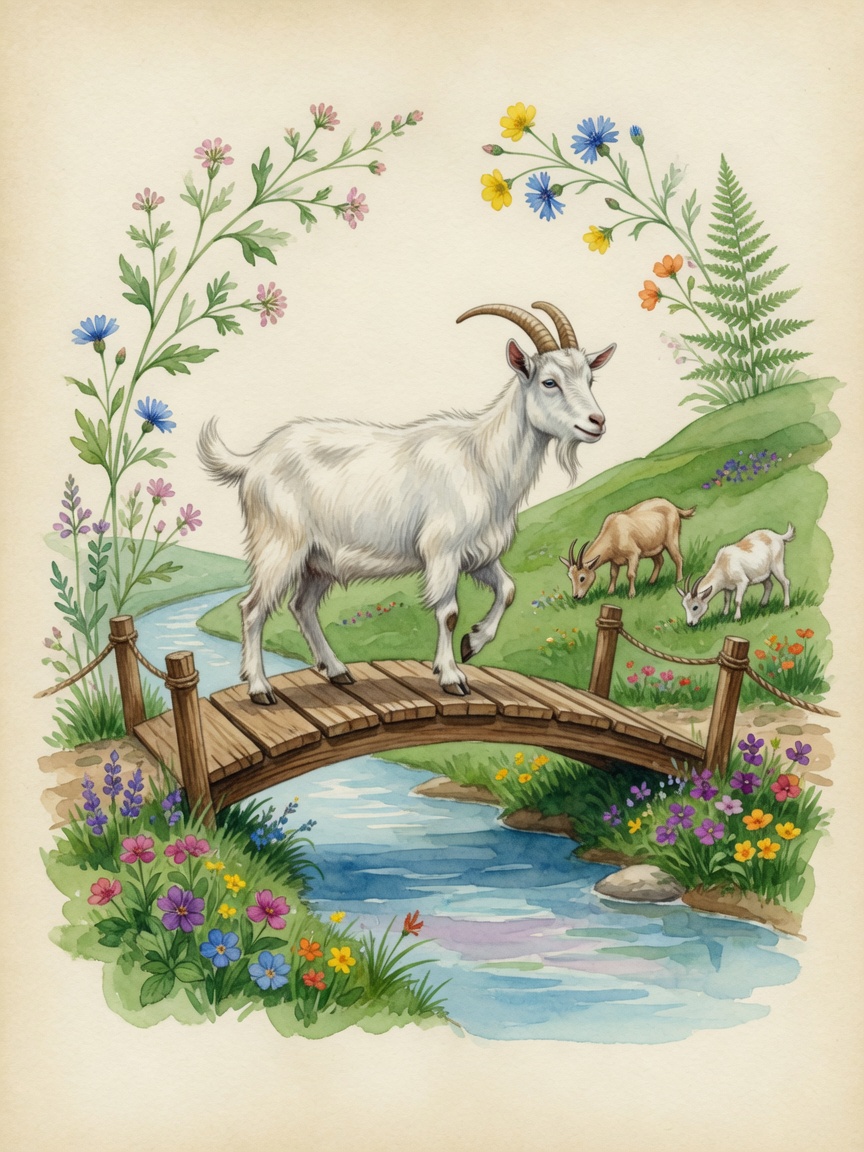
On the far side of a narrow valley stood three hills where the grass grew thick and sweet. Three brothers lived there, all goats, and all named Gruff. The smallest goat was hardly more than a kid, with a thin voice and quick feet. The middle goat carried more weight on his shoulders and spoke in a steadier tone. The largest goat moved slowly, each step sounding like a stone rolling downhill.
Across the valley ran a swift river, and the only way over it was a single plank bridge. Beneath the bridge lived a troll whose skin was the color of wet stone. He stayed in the shadows where the water dripped, listening for footsteps above. When anything crossed, he would reach up with long arms and pull it down.
Winter had been hard. The grass on the brothers’ side grew thin and brown, and their ribs showed beneath their coats. The largest brother said they must cross to the far hills where the pasture stayed green even in the cold months. The others agreed, though none spoke of the troll.
The smallest goat set out first, while the sun was still low. His hooves tapped the planks like rain on a tin roof. Halfway across, the boards bent under his light weight and a shadow stirred below. A voice like gravel poured into a bucket called up, 'Who’s that tripping over my bridge?'
The little goat stopped. His knees shook, but he answered in his highest voice, 'It is only I, the smallest Billy Goat Gruff, going to the far hills to make myself fat.' The troll’s breath hissed through the cracks. 'Then I’m coming up to gobble you.'
The smallest goat spoke quickly, before the troll could move. 'Wait. My brother comes after me, and he is larger. Eat him instead, and you will have more meat.' The troll considered the offer, tasting the idea like a sour berry. At last he grunted and sank back into the dark water.
The little goat finished the crossing in three quick bounds and disappeared into the new grass. His heart still knocked against his ribs, but the hillside smelled of clover and safety. He did not look back.
By midday the middle goat started across. His steps were heavier, and the planks complained under each hoof. Again the troll’s voice rose from below. 'Who’s that tripping over my bridge?'
The middle goat answered in a firmer tone, 'It is I, the middle Billy Goat Gruff, going to join my brother and grow fat on the green hills.' The troll’s claws scraped the underside of the wood. 'I’m coming up to gobble you.'
The middle goat held his ground. 'My brother follows, and he is the largest of us all. His legs are thick and his sides are broad. You will eat better if you wait for him.' The troll’s hunger argued with his patience. At last he muttered and let the planks settle back into place.
The middle goat crossed without hurrying, though his ears stayed pricked for any sound of climbing. When he reached the far side, he found his younger brother already cropping the new grass. They touched noses briefly but said little. Both watched the empty bridge.
The sun dropped lower, painting the river orange. The largest goat waited until the light began to fade before he moved. He did not rush. Each step landed with a solid thud that sent splinters of sound into the water below.
When he reached the middle of the bridge, the troll’s voice came again, louder now and edged with certainty. 'Who’s that tripping over my bridge?' The largest goat did not answer at once. He lowered his head so his horns caught the last light.
The troll waited, then spoke once more. 'Speak, or I climb.' The goat answered at last, his voice low and even. 'It is I, the largest Billy Goat Gruff. I go where I please.' The troll laughed, a wet, broken sound. 'Then I’m coming up to gobble you.'
Water splashed as the troll pulled himself onto the planks. His shoulders were broad as a barrel, and his eyes glowed like marsh light. The goat stood still, measuring the distance between them.
The troll lunged. The goat met him with lowered horns and drove upward. The planks cracked. One horn caught the troll beneath the ribs and lifted him clear of the bridge. For a moment the creature hung in the air above the river, arms flailing, then fell with a heavy splash that sent waves against both banks.
The largest goat waited until the ripples smoothed. No voice rose from the water. He walked the rest of the way across, hooves ringing on the wood now empty of threat. On the far hillside his brothers lifted their heads at the sound.
The three goats grazed together through the long evening. The grass was deep and untouched. No shadow moved beneath the bridge, and the river spoke only its own quiet language.
Days passed. The goats grew round and glossy. The smallest one sometimes stood at the edge of the hill and looked toward the plank bridge, but he never returned to cross it. The middle goat stayed close to his elder brother, learning the places where the sweetest clover grew.
The largest goat kept watch longest each night. He did not speak of the troll, yet every evening he walked the ridge above the river and listened. The water ran the same, but something in its voice had changed.
Other creatures began to use the bridge. A fox crossed at dawn, a hare at dusk. The planks no longer trembled at every step. The troll’s absence became a fact the valley accepted without question.
Winter returned. Snow lay along the riverbanks and ice formed at the edges of the planks. The goats stayed on the green side, sheltered by a stand of firs. Their breath rose in white plumes when they spoke.
When spring came again, the smallest goat ventured first onto the bridge. He walked slowly this time, testing each board. Halfway across he paused and looked down. Only his own reflection stared back from the moving water.
The middle goat followed, then the largest. They crossed together without hurry, the sound of their hooves steady and untroubled. On the far side they turned once to look at the empty space beneath the planks, then moved on to the new grass.
The valley kept its old shape. The river kept its voice. The bridge remained a simple thing of wood and nails, useful to any who needed to pass. The goats never forgot what had lived there, but they did not let the memory shrink their world.
Travelers who crossed in later years sometimes felt a chill when the wind blew up from the water, yet nothing rose to meet them. The story of the three brothers traveled farther than the goats themselves ever did, told beside winter fires and summer doorways.
Children listening by those fires learned to measure their steps on uncertain ground and to speak carefully when something hungry asked a question. The valley, the bridge, and the river remained, waiting for the next set of feet.