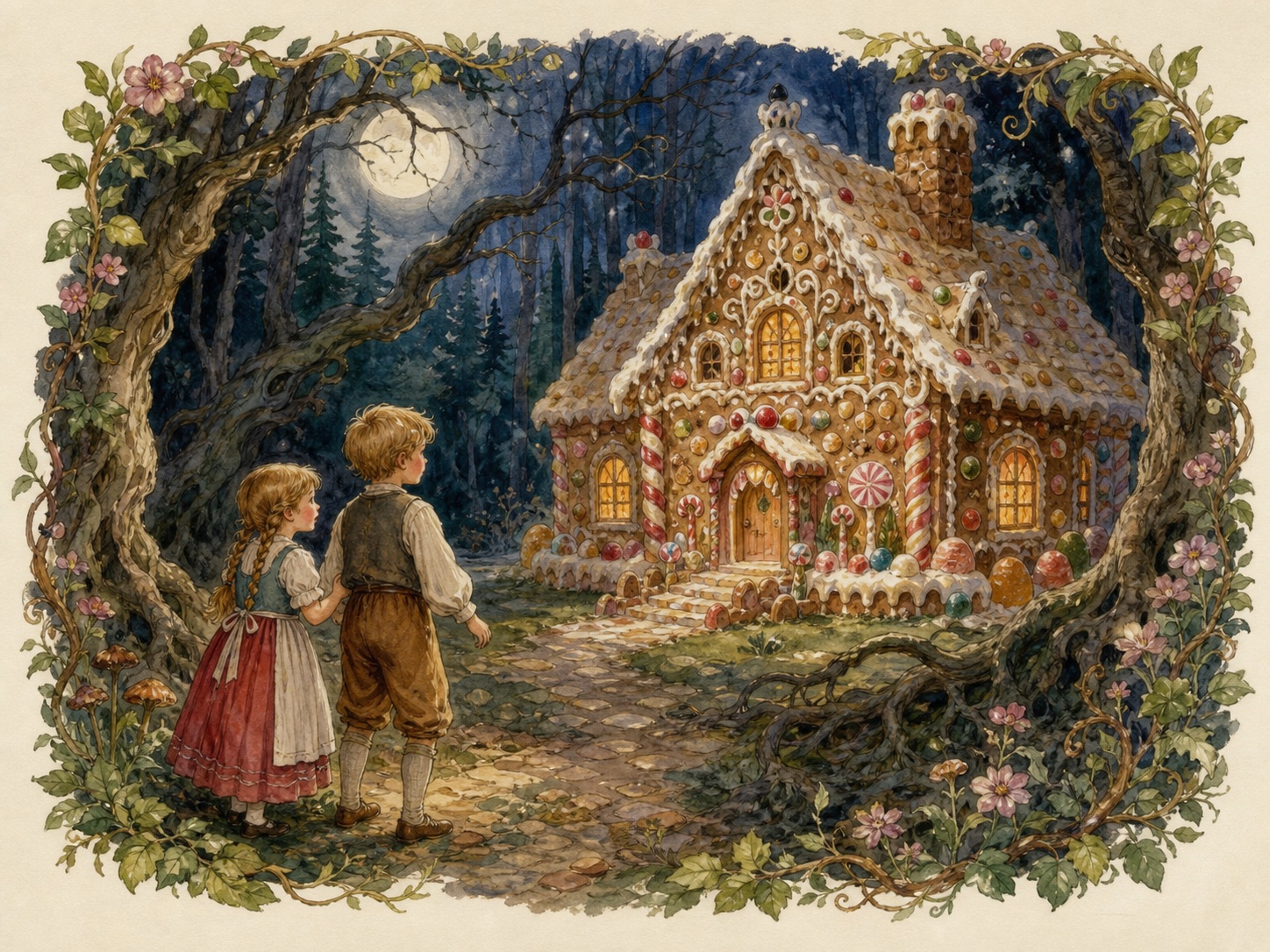
Once upon a time, at the edge of a great forest, a poor woodcutter lived with his wife and two children, a boy named Hansel and a girl named Gretel. Their little house stood at the foot of a hill, and the woods pressed close on every side.
Times grew hard. The harvest failed, and there was not enough bread for all four to eat. The wife lay awake at night, worrying about the empty cupboard and the hungry mouths. At last she said to her husband, 'We cannot feed the children. Tomorrow we must take them deep into the forest and leave them there. They will never find their way back, and we shall have one less mouth to feed.'
The woodcutter was troubled and said, 'Wife, how can we abandon our own children?' But she answered, 'If we do not, we will all starve together. There is no other way.' The man sighed and agreed, though his heart was heavy.
Hansel and Gretel heard every word through the thin wall. Gretel began to weep, but Hansel whispered, 'Do not cry. I will find a way.' When the house grew quiet, he slipped outside. The moon shone bright and white. He filled his pockets with smooth white pebbles that lay scattered by the doorstep.
The next morning, before the sun rose, the mother shook the children awake. 'Get up,' she said. 'We are going into the forest to gather wood.' She gave each a small crust of bread and led them away. Hansel lingered behind, dropping a pebble every few steps along the path.
They walked deep among the trees until they reached a clearing. The father built a fire and told the children to rest while he and their mother gathered sticks. The children sat by the flames and ate their bread. Hours passed. The fire burned low. Still the parents did not return.
When night fell, Gretel grew frightened. 'How will we find our way home?' she asked. Hansel smiled and pointed to the shining pebbles. 'Look,' he said. 'They gleam like silver coins.' The children followed the trail of white stones all the way back to their door.
Their mother opened it and pretended surprise. 'Where have you been?' she cried. The father embraced them and gave them the last of the milk. But the next week the cupboard was bare again, and the wife began to whisper the same plan.
Hansel tried to gather pebbles once more, but the door was bolted. In the morning the mother gave each child a crust and hurried them into the woods. This time Hansel crumbled his bread and dropped the crumbs behind him as they walked.
They traveled farther than before. The father built another fire and left them. When darkness came, the children looked for the crumbs, but the birds of the forest had eaten every one. No trail remained.
They wandered all night and all the next day. The trees grew taller, the shadows deeper. Their stomachs ached. At last they saw a little house standing in a glade. Its roof was made of gingerbread, its windows of clear sugar, and its walls of fresh bread.
Hansel broke off a piece of the roof. Gretel tasted the windowpane. A thin, cracked voice called from inside, 'Nibble, nibble, little mouse. Who is nibbling at my house?' The children answered, 'Only the wind, only the wind.' They kept eating.
The door opened. An old woman with red eyes and a crooked cane stepped out. 'Come in, my dears,' she said. 'You must be tired and hungry.' She led them to a table set with milk, pancakes, and apples. They ate until they could eat no more, then fell asleep on two little beds.
The old woman was not kind. She had built the house to lure children. When they slept, she locked Hansel in a stable with a barred door. In the morning she woke Gretel and said, 'You will cook for your brother and make him fat. When he is plump, I will eat him.'
Each day the witch brought Hansel rich food. Each morning she made him stretch out a finger so she could feel whether he was growing fat. Hansel held out a thin chicken bone instead. The old woman, whose eyes were weak, felt the bone and grumbled that he was still too lean.
Weeks passed. Gretel grew thin from worry and work. One evening the witch said, 'I can wait no longer. Heat the oven. Tomorrow I will bake bread, and your brother will be the feast.' She showed Gretel how to crawl inside and test the heat. 'Is it hot enough?' she asked.
Gretel understood the danger. She answered, 'I do not know how to tell. Please show me.' The old woman bent low and peered into the oven. With all her strength, Gretel pushed the witch inside and slammed the iron door. The witch screamed once and then was silent.
Gretel ran to the stable and freed Hansel. Together they searched the house. In a chest they found chests of pearls and precious stones. They filled their pockets and set out to find their way home.
They walked for many hours. The forest seemed less dark. At last they heard the sound of axes and recognized the path that led to their father's clearing. They ran the final distance.
Their father sat alone by the hearth, weeping. When he saw his children, he rose with a cry of joy. He told them their mother had died while they were gone. The three embraced and wept together.
Hansel and Gretel emptied their pockets. The pearls and jewels spilled across the table. The woodcutter stared in wonder. From that day the family had enough to eat and never wanted for anything again.
In the evenings the father told the story to neighbors who came to listen. The children added details: the taste of the sugar window, the feel of the chicken bone, the heat that poured from the oven door.
Sometimes, on clear nights, they walked to the edge of the trees and looked back at the path they had once followed. The forest stood quiet. No lights showed among the trunks.
Gretel kept one small pearl in a wooden box. She said it reminded her that even a single bright thing can mark the way when all else is lost.
Hansel learned to carve small animals from scraps of wood. He gave them to children who visited, and they carried the figures home as keepsakes.
The woodcutter mended the roof and planted a garden. The vegetables grew tall, and the gate no longer creaked in the wind.
Years later, when travelers asked the way through the forest, the family pointed to the safe paths and warned against the deeper trails where bread might still tempt the unwary.
And so the children who had once been lost became the ones who guided others home.
The house at the forest's edge remained simple, but it was never empty, and the fire on the hearth never went out.