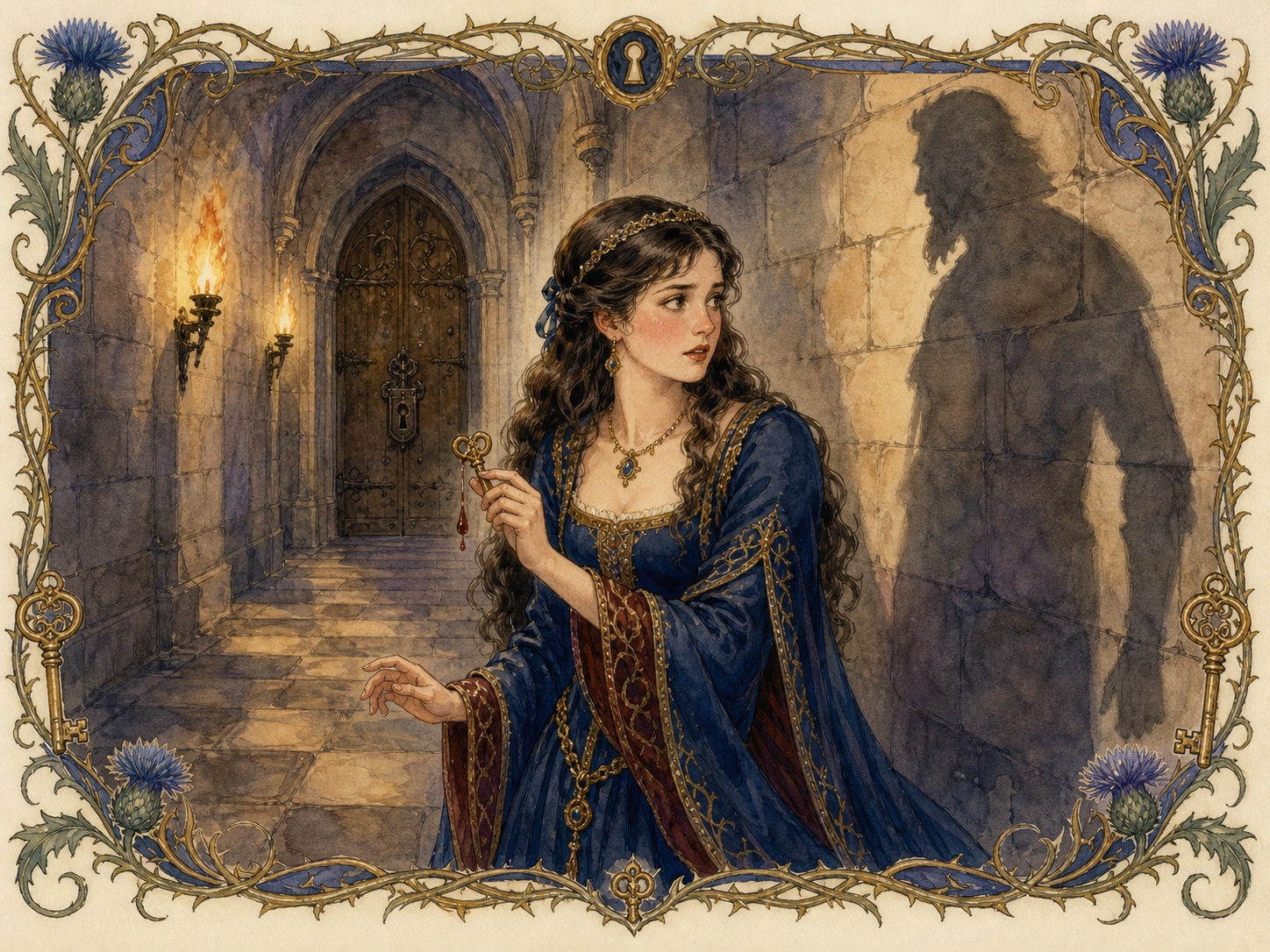
There once lived a man whose beard was so black it looked blue when the light struck it. He was rich enough to keep a great house with gardens and stables, yet no one in the country liked to visit him. People said his wives had all disappeared and no one knew where they had gone.
One summer day Bluebeard rode up to a neighbor’s door and asked whether he might marry one of her two daughters. The older daughter refused at once. The younger daughter, Anne, was not sure. She had heard the stories, but she had also seen the gold dishes and the fine carriages that came and went from his gates.
Bluebeard invited both sisters, their mother, and several friends to spend a week at his castle. They rode through an avenue of chestnut trees and came at last to a courtyard where fountains played and swans glided on a long pond. Servants brought trays of fruit and little cakes shaped like shells. Everyone ate and laughed, and for a little while the old fears seemed foolish.
On the last evening Bluebeard took the younger sister aside. He spoke gently. If she would marry him, he said, she would have the keys to every room, every cupboard, every chest. She could ride any horse, wear any gown, and call any musician she pleased. The girl thought of the music and the horses and said she would.
The wedding was held in the great hall under painted beams. Afterward the guests stayed three more days, and then they went home. Bluebeard kissed his new wife’s hand and told her he must leave at once on business that would keep him away a month. He laid a ring of heavy iron keys on the table and pointed to each one.
This key opens the cellars, he said. This one opens the silver room. This one opens the library where the books are chained. And this small key, he added, opening a cupboard no higher than his knee, this opens the little room at the end of the west passage. You may go anywhere you like, but you must never use that key.
His wife asked why. Bluebeard only smiled and said the room was his own, and he wished it to remain so. Then he climbed into his coach, the horses started, and the sound of wheels faded down the avenue.
For three days the young wife walked through the castle like a queen. She opened every door except one. The servants brought her anything she asked for, yet the silence of the long corridors began to press on her. At night she lay awake and thought of the little cupboard and the small key that weighed almost nothing in her hand.
On the fourth morning she could wait no longer. She took a candle, though it was bright day, and walked the west passage until she found the door. The key turned with a sound like a dry branch snapping. She pushed the door open and lifted the candle.
The room was not large. Its walls were the color of dark slate. On the stone floor lay seven shapes wrapped in white cloth, and from beneath each cloth a thin line of blood had run and dried. She knew at once that the shapes were the missing wives.
She stepped back so quickly that the candle shook and went out. The darkness seemed to move toward her. She shut the door, turned the key, and leaned against the wall until her breath slowed. Then she saw that the key was wet with blood along its edge. She wiped it on her skirt, but the blood stayed.
She tried polishing the key with a linen cloth, then with sand from the garden path, then with salt. The blood would not move. At last she hid the key in her sleeve and went to her room, telling herself she would think of something by morning.
That night a messenger arrived with a letter. Bluebeard wrote that his business had ended sooner than he expected. He would reach the castle the next afternoon. The servants began to polish silver and set out fresh linen. The young wife walked the battlements and watched the road.
Her sister Anne arrived at noon to keep her company. The two young women sat by an upper window that looked over the fields. They saw dust rising far away and knew it was Bluebeard’s coach.
When the coach stopped at the steps, Bluebeard stepped down and called for his wife. She came down slowly, trying to keep her hands from shaking. He kissed her cheek, then asked at once for the keys. She brought the ring from the table where she had left it, but the small key was still hidden in her sleeve.
Bluebeard counted the keys one by one. When he reached the last place on the ring and found it empty, his face changed. Where is the key to the west room, he asked. His voice was quiet, but it filled the hall.
The young wife tried to smile. She said she must have left it upstairs. Bluebeard told her to fetch it. She climbed the stairs, took the key from her sleeve, and saw again that the blood had not dried or faded. She rubbed it once more on the stair carpet. The carpet stayed clean and the key stayed red.
She came down again and held the key out. Bluebeard took it between two fingers. He looked at the blood, then at her face. You have been in the forbidden room, he said. Now you must go there and stay there.
She stepped back. She asked whether he would give her a little time to pray. Bluebeard looked at the tall clock in the corner. You have one quarter of an hour, he answered. When the quarter strikes, you will come with me.
She ran up the tower stairs to the highest window. Anne was still sitting there, looking out over the fields. Sister Anne, the wife cried, do you see our brothers coming? They had promised to visit before the month ended. Anne shaded her eyes. I see nothing, she said, only the green of the fields and the dust on the road.
The wife went down one flight and asked again. Sister Anne, do you see anyone? Anne answered that she saw a flock of sheep and a man leading a cart, nothing more. The clock below began to whirr as it gathered its strength to strike.
The wife climbed once more. Sister Anne, she called, look again, as far as you can see. Anne stood on the window seat and leaned out. I see two horsemen, she said at last, riding fast with the sun on their helmets.
The quarter began to strike. Bluebeard’s voice rose from the bottom of the stairs. Time is finished, he called. The wife kissed her sister and went down to meet him. She asked whether she might say goodbye to the servants. Bluebeard shook his head.
He took her by the arm and led her along the west passage. The door stood open. Inside, the white cloths had been drawn back. Bluebeard pointed to an empty space on the floor between two of the shapes. Kneel there, he said.
At that moment the door at the end of the passage burst open. The two brothers, who had ridden without stopping since Anne’s first signal, came in with drawn swords. Bluebeard reached for his own weapon, but the younger brother struck first. Bluebeard fell and did not rise again.
The brothers lifted their sister from the floor. They wrapped her in a cloak and led her out through the courtyard where the fountains still played. The servants, seeing what had happened, opened every gate and let the three ride away.
In time the castle and all its lands were divided among the people who had served there honestly. The young widow and her sister went to live with their brothers in a smaller house nearer the town. They kept the keys of that house on a plain wooden ring, and no door in it was ever forbidden.