Once, in a quiet village, there lived a miller who had a daughter with quick hands and a steady heart. One market day the miller stood at the edge of the crowd and heard the king’s riders pass. Pride rose in his chest like yeast in warm dough, and before he could stop himself he called out that his daughter could spin straw into gold. The words floated up to the riders and were carried straight to the palace.
The king, who loved gold above every other thing, sent for the girl at once. When she stood before him, he pointed to a small room filled to the ceiling with straw and set a spinning wheel beside the door. “If by morning this straw is gold,” he said, “you shall live in honor; if not, you will lose your life.” Then the door closed and the key turned.
The girl sat alone on the cold floor. Moonlight slipped between the shutters and lit the pale stalks that smelled of dust and late summer fields. She had never touched a spinning wheel, yet the king expected miracles. Tears slipped down her cheeks and fell onto the straw like tiny rain.
Near midnight the door latch clicked. A little man stepped inside, no taller than the wheel itself, with eyes bright as new coins. “What will you give me,” he asked, “if I spin this straw for you?” The girl offered her necklace, and the little man sat down without another word. His feet pumped the treadle; the wheel hummed like a hive.
By sunrise every wisp of straw had become fine gold thread wound on heavy spools. When the king opened the door, his eyes widened. He led the girl to a larger room, even deeper with straw, and promised her great reward if she could do the same again. Once more the door was locked.
That night the little man returned. The girl gave him the ring from her finger, and again the wheel sang until dawn. On the third evening the king filled the largest hall in the castle. “One last night,” he said, “and if you succeed you shall be queen.” The girl had nothing left to give.
When the little man appeared, she spread her empty hands. “Then promise me your first child,” he said, “once you are queen.” In her fear she nodded, and the straw became gold while she slept.
A year later the girl was queen, and she held a newborn son whose cry filled the palace like a bell. She had almost forgotten the promise until the little man stepped from behind the curtains. “Give me the child,” he said. The queen wept and offered him all the treasure in the kingdom instead. The little man shook his head. “A promise is a promise,” he answered, “but I will give you three days. If you can guess my name, the child stays with you.”
The queen sent messengers across the land. They wrote down every strange name they heard—names from mountains, names from the sea, names whispered in market squares. On the first night she recited them all, yet the little man answered each time, “That is not my name.”
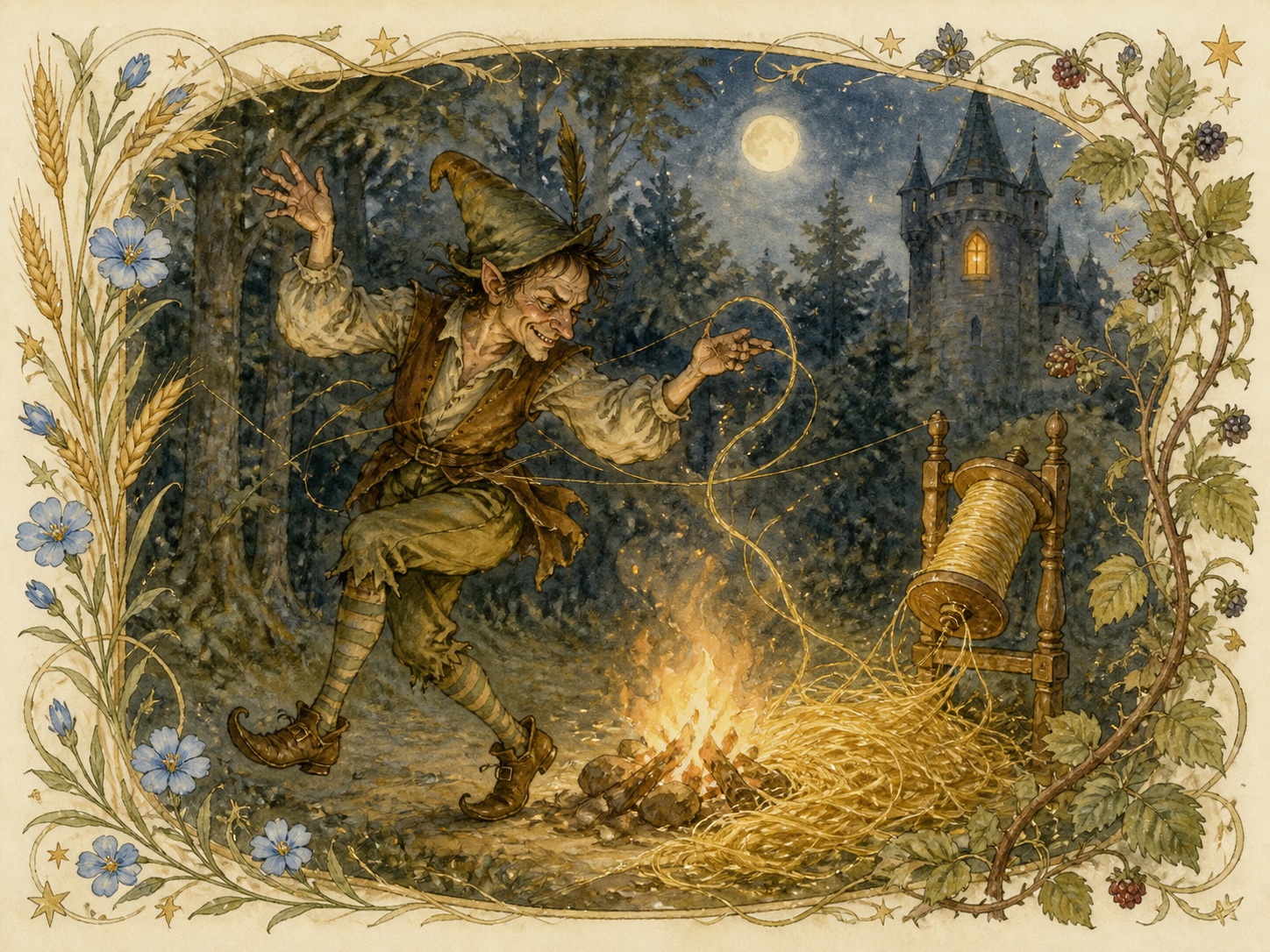
On the second day a messenger rode into deep woods where trees grew so close the sky disappeared. He saw a small hut with smoke curling from its chimney. Near the hut a fire burned, and the little man hopped around it on one leg, singing, “Today I brew, tomorrow I bake, and then the queen’s child I will take; for little knows my royal dame that Rumpelstiltskin is my name.” The messenger hurried home with the secret.
On the third evening the queen waited until the little man stood before her. She spoke every name she had been given before, and each time he smiled. At last she said softly, “Is your name perhaps Rumpelstiltskin?” The little man’s face turned red as flame. He stamped his foot so hard that it sank into the stone floor up to the knee. With his other foot he pulled himself free, then stamped again and split himself in two.
And that was the end of him. The queen kept her child, the king kept his gold, and the village remembered the miller’s boast only as a story told beside winter fires.
In the days that followed, the queen often walked through the spinning room where the straw had once stood in golden heaps. She ran her fingers along the smooth wood of the wheel and remembered the little man’s quick feet and bright eyes. The memory was sharp, like the scent of fresh straw after rain.
Sometimes at twilight she heard the echo of the treadle in the empty hall, though no one sat at the wheel. Servants said the sound was only wind in the rafters, but the queen knew better. She kept the room locked and the key on a chain at her waist.
The little prince grew, and when he was old enough to ask questions he pointed to the sealed door. His mother told him the story without the smallest lie, and the boy listened with wide eyes and a still mouth. He never asked to see inside.
On clear nights the queen would stand at the window and watch the moon rise over the fields where the straw had been cut. She thought of promises made in fear and of names carried on the wind. The kingdom prospered, yet she never again boasted of anything she could not do with her own hands.
Travelers who passed through the village sometimes heard the tale from old millers who still ground grain by the river. They told it with low voices and long pauses, letting the children feel the weight of each closed door and each opened secret.
In the palace garden the queen planted a small plot of rye. Every spring the green stalks whispered together, and every autumn the grain was cut and bound. She kept one sheaf above the hearth as a reminder that straw stays straw unless a true hand changes it.
The king, too, changed after that night. He spent less time counting coins and more time walking with his son through the stables and the kitchens. Gold remained in the treasury, but it no longer ruled every decision made beneath the crown.
Years later, when the prince was nearly grown, a wandering minstrel came to the castle gate. He carried a lute carved with tiny spinning wheels. After supper he sang the story of Rumpelstiltskin, and the queen sat among her people and listened as if hearing it for the first time.
When the last note faded, the minstrel asked whether the tale was true. The queen answered that every story worth keeping holds at least a grain of truth, and she gave him a silver coin for his song. The minstrel bowed and went on his way.
In the village, mothers began to warn their children never to promise what they could not give. The warning was not spoken harshly; it was tucked into lullabies and bedtime tales so the children would carry it without fear.
On stormy evenings the wind sometimes blew straw against the palace shutters. Servants gathered the pieces and burned them in the kitchen hearth. The queen watched the sparks rise and remembered how gold had once looked in firelight—bright, but quick to fade if not guarded well.
The little prince learned to spin wool, not straw. His mother sat beside him and showed him how to keep the thread even. When his hands grew tired she told him the wheel would wait, and that some tasks are better done slowly than not at all.
On the anniversary of the night the little man disappeared, the queen placed a bowl of milk and a crust of bread on the windowsill. She did not know if he would ever return, but the offering felt right. By morning the bowl was empty and the bread gone, though who had taken them no one could say.
The kingdom’s records listed the queen’s name beside her husband’s, yet in the margins of those same books a scribe sometimes drew a tiny figure no taller than a spinning wheel. The drawings were never explained, but children who found them smiled and turned the page.
And so the story lived on, passed from one winter to the next, changing only in the voices that told it. Each teller added the sound of the wheel or the color of the straw or the feel of the stone floor beneath a frightened girl’s feet. The ending stayed the same: a name spoken at the right moment, a promise kept, and a child safe in his mother’s arms.