Long ago there lived a merchant whose daughter, Vasilisa, was gentle and capable. When the girl was still young, her mother became gravely ill. Before she died, she called Vasilisa close and placed a tiny wooden doll in her hands. “Keep her hidden,” she whispered. “When sorrow corners you, give her a little food and ask her counsel. My blessing will remain with you.”
After a time the merchant married again. His new wife had two daughters of her own, and all three resented Vasilisa’s quiet beauty and skill. They gave her the roughest work, hoping wind and sun would spoil her face. Yet Vasilisa carried each task through. At night she shared a crumb with the doll, and by morning the hardest work was done.
When the merchant traveled far on business, the stepmother moved the household to a lonely house near a black forest. She knew that Baba Yaga lived somewhere beyond the trees and hoped the witch would rid her of Vasilisa. One autumn evening she gave each girl needlework, then secretly ordered that every candle and coal in the house be put out.
The house grew cold and dark as the fire died. Vasilisa's stepmother sat by the empty hearth and frowned. She told her own daughters to stay inside while Vasilisa must go into the woods for a light. The two stepsisters laughed and said the task was too dangerous for them.
Vasilisa wrapped her shawl tightly around her shoulders. She looked at the black trees beyond the garden fence and felt her heart beat faster. Still, she knew she could not disobey. She slipped the little wooden doll into her pocket and stepped outside.
The path into the forest was narrow and overgrown. Leaves whispered above her head, and the ground was soft with moss. Vasilisa walked carefully, listening for any sound that might warn of danger.
As she walked deeper, the light faded until only a pale glow came through the branches. Vasilisa felt the doll shift gently in her pocket, as if reminding her she was not alone.
After many hours she reached a clearing where three riders passed her. The first wore white, the second red, and the third black. They did not speak to her, yet she sensed they marked the passing of day, sun, and night.
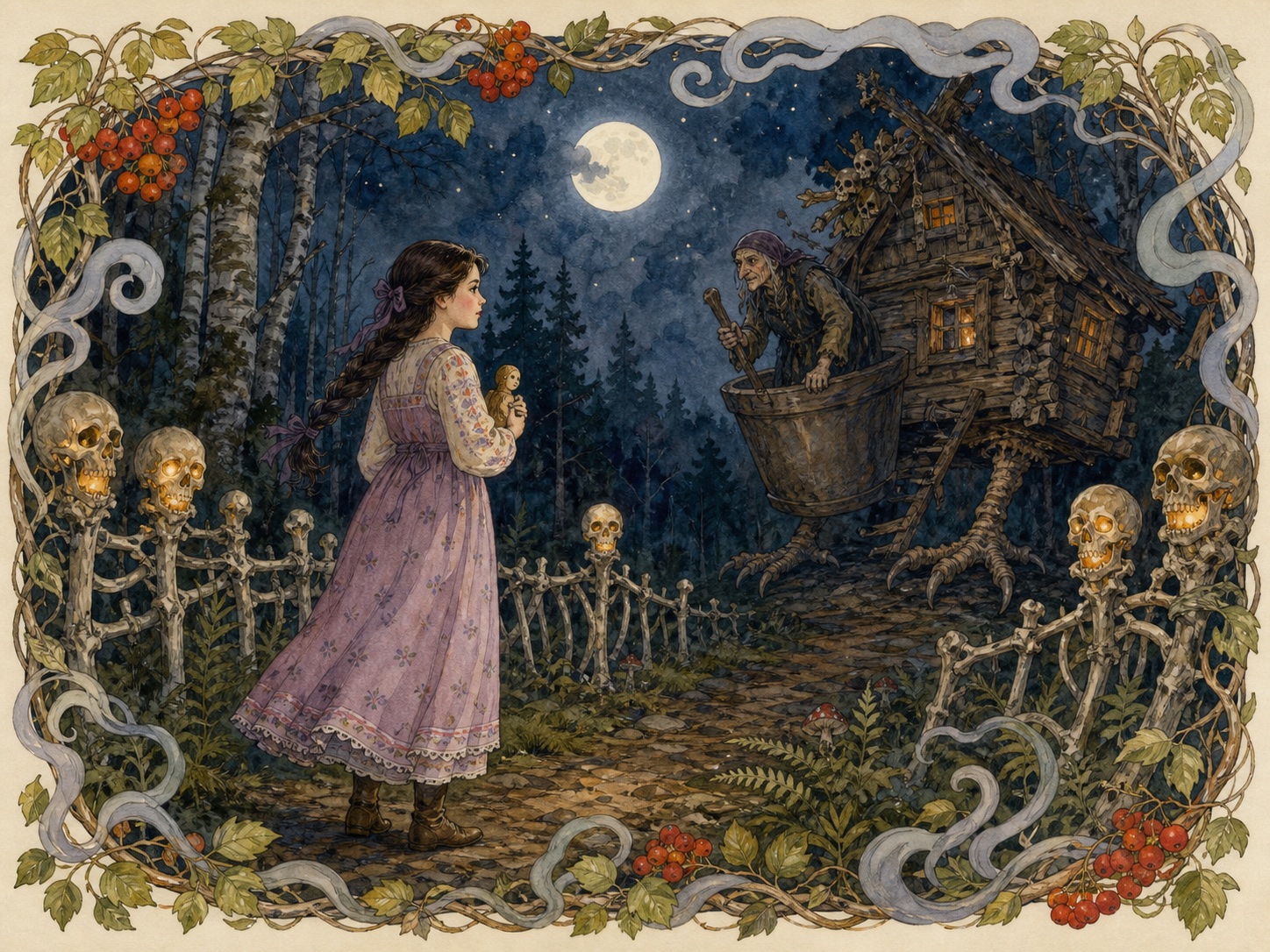
At last Vasilisa saw a strange house standing on giant chicken legs. The house turned slowly, creaking with every step, and its windows glowed like watchful eyes. A tall fence of bones surrounded the yard, and skulls with burning coals inside them sat on each post.
Vasilisa stood very still. She took a deep breath and called out in a clear voice, asking permission to enter. The house turned toward her and lowered itself until its door faced the path.
Baba Yaga appeared on the porch. She was tall and bony, with iron teeth that flashed when she spoke. Her nose curved like a hawk's beak, and her hair was tangled like old roots. She demanded to know why Vasilisa had come.
Vasilisa explained that her stepmother had sent her for fire. Baba Yaga studied the girl for a long moment, then said that any favor must be earned. She invited Vasilisa inside but warned that she would be tested.
Inside the hut the air smelled of herbs and smoke. Baba Yaga sat on a bench and ordered Vasilisa to prepare supper. Vasilisa worked quickly, chopping vegetables and stirring the pot until the stew smelled rich and warm.
While they ate, Baba Yaga asked how Vasilisa had managed to travel safely through the forest. Vasilisa answered that the doll her mother had given her had guided her steps. Baba Yaga nodded and said nothing more that night.
The next morning Baba Yaga pointed to a huge pile of wheat mixed with poppy seeds. She told Vasilisa to separate every seed before nightfall or she would be eaten. Then the old woman left on her mortar and pestle, sweeping away her tracks with a broom.
Vasilisa sat before the impossible task and felt tears sting her eyes. She took the doll from her pocket and set it on the floor. The doll blinked its painted eyes and began to sort the seeds with tiny wooden hands, working faster than any person could.
By sunset the wheat stood in one clean heap and the poppy seeds in another. When Baba Yaga returned she frowned, surprised to find the work done. She praised Vasilisa's cleverness but gave her no rest.
The following day Baba Yaga demanded that Vasilisa clean the entire yard, wash all the linens, and cook another meal before the sun set again. Once more the doll worked through the night, sweeping, scrubbing, and stirring while Vasilisa rested just enough to stay on her feet.
Each evening Baba Yaga returned and found every task completed. She grew both curious and impatient, wondering what secret power the girl possessed. Yet she kept her word and did not harm Vasilisa as long as the work was finished.
On the third morning Baba Yaga asked Vasilisa who had helped her. Vasilisa answered truthfully that her mother's blessing and the little doll had done the work. Baba Yaga's eyes narrowed, but she did not strike the girl.
That night Baba Yaga told Vasilisa to go to the storeroom and fetch a measure of wheat from the highest shelf. Inside the dark room Vasilisa found a small oil lamp. She filled it carefully and carried it back, its flame steady and bright.
Baba Yaga accepted the lamp and studied Vasilisa once more. She declared that the girl had earned her fire and could now return home. Yet she warned that the flame must never go out on the journey back.
Vasilisa thanked the old woman and stepped outside. The house on chicken legs rose again, and the skulls on the fence watched her leave. She walked quickly, holding the lamp close so its light would not flicker.
Halfway home the flame wavered when a cold wind swept through the trees. Vasilisa shielded it with her shawl and whispered to the doll for courage. The flame steadied and burned on.
When she reached the village the first gray light of dawn touched the sky. Vasilisa's stepmother and stepsisters were waiting at the gate. They snatched the lamp from her hands and carried it inside, eager to see the famous fire from Baba Yaga.
The moment the lamp crossed the threshold the flame leaped high. It roared through the house, consuming curtains, beds, and wooden beams. The stepmother and her daughters cried out but could not escape the sudden blaze.
Vasilisa stood in the yard, unharmed. The doll in her pocket felt warm against her side. She watched the fire burn until only ashes remained, then turned and walked away from the ruined place.
She found shelter with an old woman in the village who had once known her mother. Together they rebuilt a small cottage at the edge of the fields, far from the forest. Vasilisa kept the doll on a shelf above the hearth and tended it with care.
In time she learned to spin and weave fine linen. Merchants from the city bought her cloth and spread word of its beauty. Vasilisa's reputation grew until even the tsar's son heard of the skillful girl who lived by the woods.
The tsarevich came to see her work. He watched Vasilisa's hands move gracefully over the loom and saw kindness in her eyes. He asked her to come to the palace, and she agreed, bringing only her doll and the blessing her mother had given long ago.
At court Vasilisa was welcomed. She married the tsarevich and ruled beside him with fairness. The little doll stayed in her chamber, a quiet reminder of the journey through the forest and the courage that had carried her home.
Years later, when her own children asked about the strange lamp that once burned in their grandmother's house, Vasilisa told them the story. She reminded them that help often comes from small, faithful things kept close through danger and darkness.