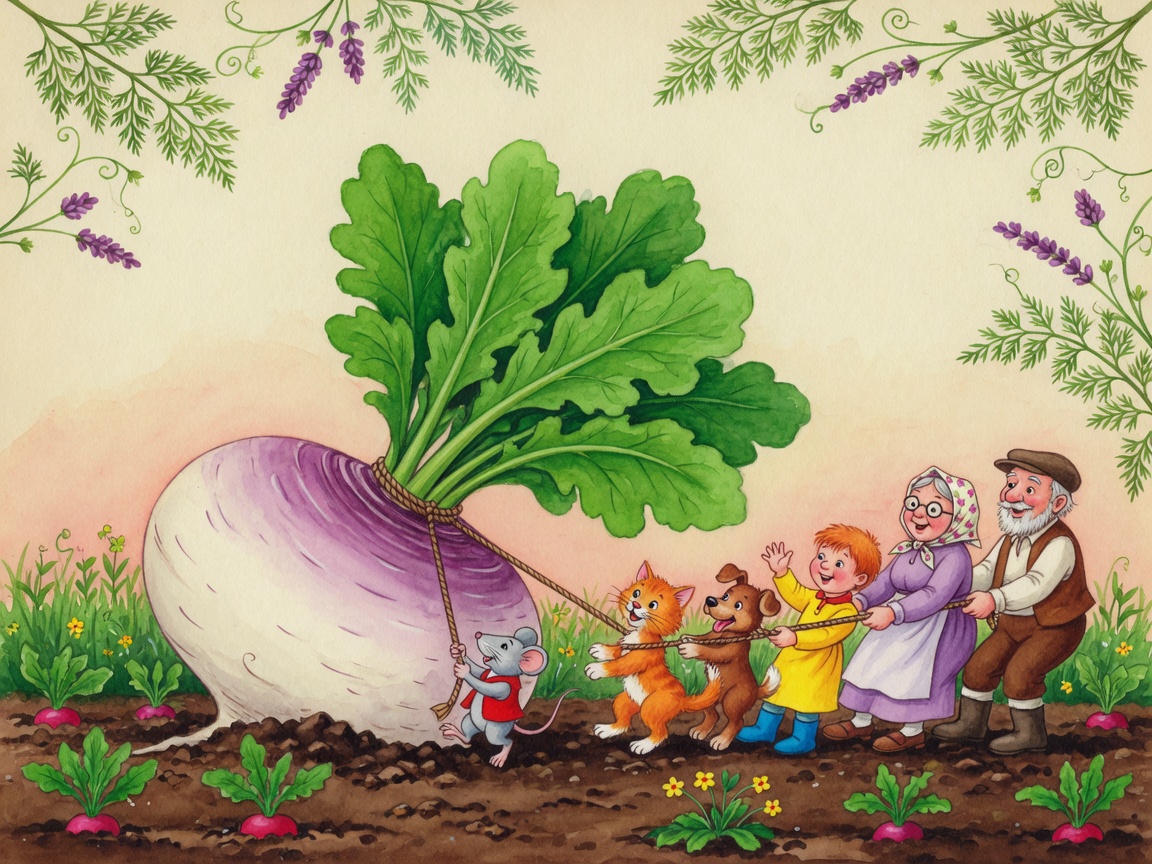
Long ago, in a village where the fields rolled like a green sea, there lived a farmer named Dedushka and his wife, Babushka. Their cottage stood at the edge of the woods, its thatch roof patched with new straw each spring. They had a little garden behind the house where the soil was dark and rich.
One spring morning Dedushka went out with a seed in his hand. It was no ordinary seed; it had come from his father, who had saved it from the best turnip of his own harvest. Dedushka pressed the seed into the ground and patted the earth around it. "Grow well," he said, and went about his other work.
Every day he carried water from the well and poured it carefully around the tiny sprout that pushed through the soil. At night he checked the sky for frost. The sprout grew into a sturdy green top, then into broad leaves that shaded the ground.
Weeks passed. The leaves spread wider. The stem thickened. One afternoon Dedushka knelt and touched the ground around the plant. Beneath the soil something round and solid met his fingers. He smiled and said nothing.
By midsummer the leaves stood taller than his knees. The stem was as thick as his wrist. Babushka came out with a basket of peas and stopped when she saw it. "That cannot be an ordinary turnip," she said. Dedushka only nodded.
When autumn came the leaves turned the color of old bronze. Dedushka decided it was time. He took his spade and set it against the earth. The blade struck something hard and would not go deeper. He tried again, pushing with both hands. The turnip did not move.
Dedushka wiped his brow. He gripped the leaves with both hands and pulled. His boots slid in the dirt. The turnip stayed fast. He called to Babushka. She came out, wiped her hands on her apron, and took hold of Dedushka around the waist. "Now pull," he said.
They pulled until their faces were red. The turnip did not yield. A neighbor passing by heard their grunts and came to the fence. "What is the matter?" he asked. "The turnip will not come out," Dedushka answered. The neighbor climbed over and took hold of Babushka. The three of them pulled together.
Still the turnip stayed in the ground. A dog that had been sleeping under the porch stood up, stretched, and trotted over. It took the neighbor’s coat in its teeth and leaned back on its haunches. The line of pull grew longer, yet the turnip would not move.
A little girl who lived down the lane heard the noise and came running. She saw the line of people and animals and laughed. Then she took hold of the dog’s tail with both hands and added her small weight to the pull.
They counted together—one, two, three—and heaved. The earth around the turnip cracked. A thin line appeared in the soil, but the root did not rise. The little girl’s face grew serious. She planted her feet wider and pulled harder.
A cat that had been watching from the windowsill jumped down and padded across the grass. It took the hem of the girl’s dress in its teeth and braced its front paws. The chain of hands, paws, and teeth lengthened.
A mouse that lived in the woodpile came out to see what the fuss was about. It took the cat’s tail gently in its mouth and joined the line without a word. Now eight creatures stood in the garden, all pulling in the same direction.
Dedushka felt something give, just a little. He took a deep breath and called, "Once more, together." The others answered with a single sound, half grunt, half cheer. They leaned back as one.
The earth split with a tearing sound. The turnip rose slowly, roots trailing soil like dark rain. It was larger than a washtub, round and pale, with a faint sweet smell that drifted on the breeze.
For a moment no one spoke. They looked at the turnip lying on the grass, then at one another. Their hands were sore and their clothes were streaked with dirt, but their faces were bright.
Dedushka set his spade aside. "We will need the cart," he said. Babushka went to fetch a rope. The neighbor offered to bring his strong horse. The little girl ran home to tell her mother the news.
By evening the turnip rested on a bed of straw in the barn. Neighbors came from every cottage with lanterns. They brought bread and cheese and sat on overturned buckets while Dedushka told how the seed had grown.
Someone asked what they would do with so large a root. Dedushka answered that there would be soup for many weeks, and still some left to dry for winter. Babushka said the greens could be chopped and cooked with butter. The talk turned to how the work had been shared.
The dog lay with its head on its paws, listening. The cat washed its face. The mouse had already returned to the woodpile, but its small tracks remained in the dust near the turnip.
That night Dedushka and Babushka sat by the stove. They spoke quietly about the day. Dedushka said he had never expected the seed to grow so large. Babushka answered that the seed had done its part; the rest had been the work of many hands.
In the morning the village children came to see the turnip. They touched its smooth skin and measured their arms against its width. Dedushka let each child help scrape away the last bits of soil. The work went quickly with so many small hands.
By midday the first slices were ready. Babushka built a fire under the great kettle. The smell of boiling turnip and onion drifted across the lane. People brought their own bowls and spoons. No one left hungry.
Days passed. The turnip fed the household and the neighbors who had helped. When the last piece was gone, Dedushka saved a new seed from the heart of the root. He wrapped it in a square of cloth and placed it in the wooden box where he kept his father’s old tools.
The following spring he planted the seed in the same spot. The leaves grew tall again, but never quite so tall as before. Still, when harvest came, the turnip was large enough for the whole village to share once more.
Dedushka never forgot the day the turnip would not move until every creature had taken hold. When children asked how such a thing could happen, he answered that some tasks are too heavy for one pair of hands, no matter how strong.
Babushka kept the story alive by telling it each winter while she mended clothes by the stove. She always ended by saying that the turnip had taught them patience first, and then the strength that comes when people stand together.
Years later, when Dedushka was very old, he gave the cloth-wrapped seed to his grandson. The boy planted it with care, and when the leaves rose high, he remembered to call his friends before he tried to pull. The line formed again—hands, paws, and small feet—and the earth gave way.
The story traveled from cottage to cottage, carried in the voices of those who had tasted the soup and felt the ache in their arms. It remained a tale about a seed, a root, and the quiet fact that nothing truly large grows alone.