The firelight shelf
Classic spooky stories.
The old stories with their shadows left in: dark woods, wolves, witches, forbidden rooms, brave children, and hard-won endings.
Choose a tale
Seven complete read-alouds.
These are faithful retellings, not softened modern rewrites. The darkness has a purpose: danger is real, choices matter, and courage changes the ending.
Brothers Grimm · faithful family retelling
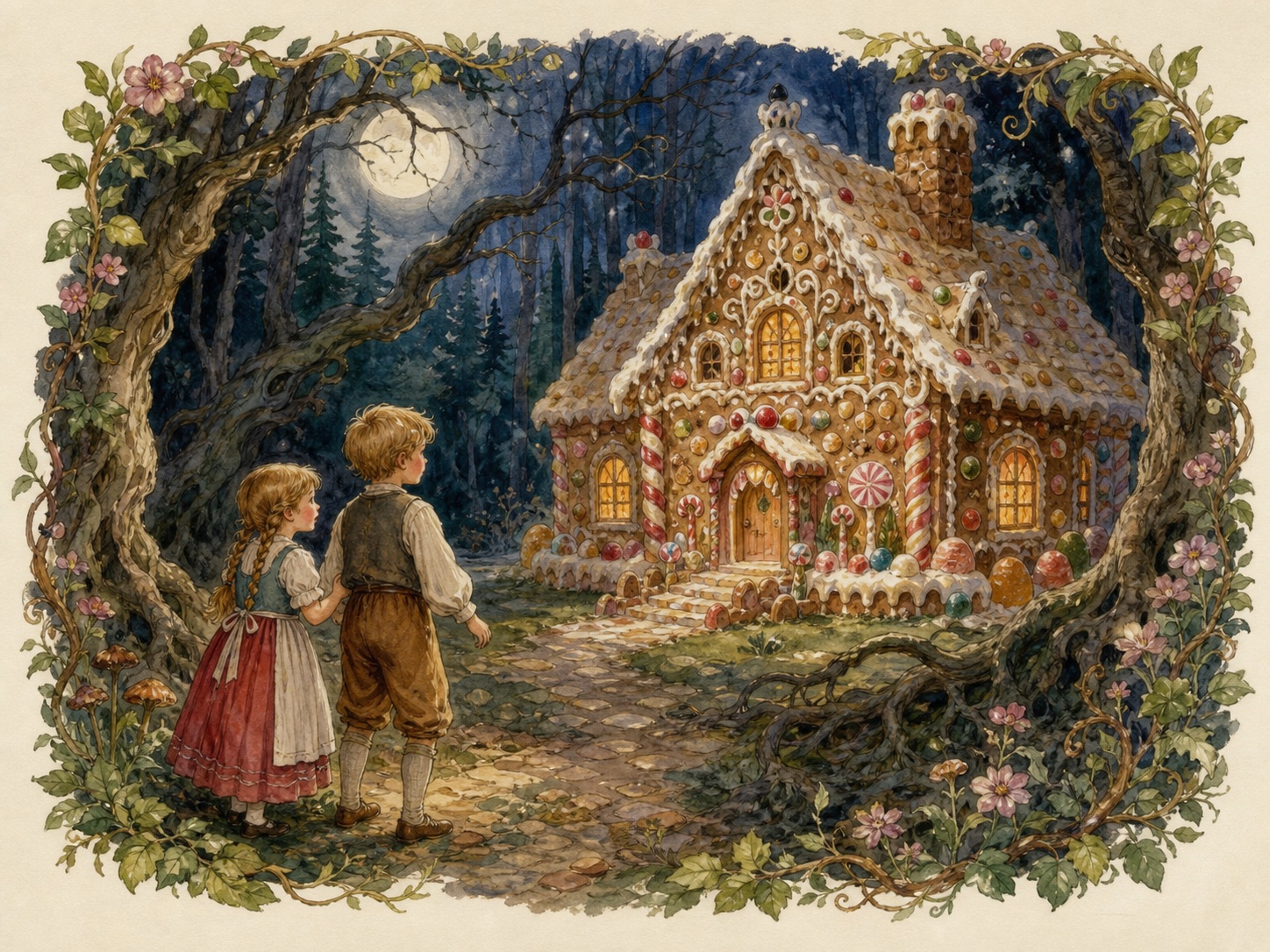
Hansel and Gretel
At the edge of a great forest lived a poor woodcutter with his two children, Hansel and Gretel, and their stepmother. Food had become so scarce that one evening there was scarcely a crust left in the house.
“There is not enough for four,” the woman told her husband. “Tomorrow we must take the children deep into the forest, give them each a piece of bread, make a fire, and leave them there. Otherwise we shall all starve.”
The father was horrified. “Wild beasts will tear them apart.”
But his wife argued until grief and hunger overcame him. In the next room, the children heard every word. Gretel wept, but Hansel whispered, “Do not fear. I will find a way home.”
When the adults slept, Hansel crept outside. Moonlight shone on the white pebbles before the cottage, and he filled his pockets with them.
At dawn the woman gave each child a small piece of bread, warning them not to eat it before noon. As the family walked into the forest, Hansel kept stopping to look back.
“Why do you lag behind?” his father asked.
“I am looking at my white kitten on the roof,” Hansel said. But he was dropping the bright pebbles one by one along the path.
Deep in the woods, the father made a fire. “Rest here,” he said. “We are going to cut wood nearby.” The children heard an axe striking long after the adults had gone, but the sound came from a branch their father had tied to a tree so the wind would beat it against the trunk.
Night fell. Gretel cried, but Hansel waited until the moon rose. Then the pebbles gleamed like new coins, and the children followed them safely home.
The father rejoiced to see them. Their stepmother did not. Before long the famine worsened, and again the children heard her insist that they be taken away—this time farther than before. She locked the door, so Hansel could gather no stones.
The next morning he crumbled his bread in his pocket and scattered the crumbs along the path. Once more the children were left beside a fire. Once more the false axe knocked until evening.
But when the moon rose, there was no shining trail. Birds had eaten every crumb.
For three days Hansel and Gretel wandered. They drank from clear streams and slept beneath trees, but found no path home. On the third morning they saw a snow-white bird. Its song was so beautiful that they followed it until they came to a little house made of bread, with a roof of cake and windows of clear sugar.
“We shall have a feast,” said Hansel. He broke a piece from the roof while Gretel tasted a windowpane.
A thin voice called from inside, “Nibble, nibble, little mouse—who is nibbling at my house?”
The children answered, “Only the wind,” and went on eating.
An old woman came out leaning on a stick. “Dear children,” she said sweetly, “come inside. No harm shall come to you.” She served pancakes, milk, apples, and nuts, then tucked them into two clean beds.
But the old woman was a witch. She had built the house to lure children, for she had dim eyes but a keen nose and could smell a child from far away.
At dawn she seized Hansel and locked him in a barred stall. Then she shook Gretel awake. “Cook something good for your brother. When he is fat, I shall eat him.”
Each morning the witch ordered Hansel to put out his finger so she could feel whether he had grown plump. Hansel held out a little bone he had found in the stall. Because the witch could not see well, she mistook it for his finger and wondered why he remained so thin.
After four weeks she lost patience. “Thin or fat, tomorrow I shall cook him.” She ordered Gretel to fill the great kettle, then bent before the oven. “Crawl in and see whether it is hot enough.”
Gretel understood that the witch meant to bake her first. “I do not know how,” she said. “Where do I get in?”
“Stupid child! The opening is large enough. Look—I could get in myself.”
The witch thrust her head and shoulders into the oven. Gretel gave her one mighty push, slammed the iron door, and fastened it. The witch shrieked, but Gretel did not open the door.
She ran to Hansel, broke the lock, and cried, “We are free!” Together they searched the witch’s house and found chests filled with pearls and precious stones. They filled their pockets.
After walking for hours, they reached a broad stretch of water. A white duck carried them across one at a time. Beyond it the forest became familiar, and at last they saw their father’s cottage.
The woodcutter had known no happiness since leaving them. Their stepmother was dead, and he had mourned his children every day. Hansel and Gretel ran into his arms, then poured the jewels onto the table. Hunger and fear were ended, and the three lived together in peace.
About the old story: In the first Grimm printing, the woman is the children’s mother; later editions call her their stepmother. The witch is burned in her own oven, and the children return with her treasure. Those hard edges belong to the tale.
Brothers Grimm · faithful family retelling
Little Red Riding Hood
There was once a dear little girl whose grandmother gave her a hood of red velvet. She wore it so often that everyone called her Little Red Riding Hood.
One morning her mother gave her a basket with cake and wine. “Take these to Grandmother. Keep to the path, and do not run, or you may fall and break the bottle.”
Grandmother lived half an hour away, deep in the woods. Before long a wolf met the child. She did not know what a wicked creature he was, so she was not afraid.
“Where are you going so early?” he asked. Red Riding Hood told him everything—even where Grandmother lived. The wolf looked at the flowers beneath the trees and said, “How pretty the forest is! Why not gather a bouquet?”
As the child wandered from the path, the wolf ran straight to the cottage. He knocked, imitated the girl’s voice, and told Grandmother he had brought cake and wine. The sick old woman called for him to lift the latch. He sprang inside and swallowed her whole.
Then he put on her nightgown and cap, drew the curtains, and climbed into bed.
When Red Riding Hood arrived, she found the door open. The room felt strange. She went to the bed and drew back the curtain.
“Grandmother, what big ears you have.” “The better to hear you with.”
“What big eyes you have.” “The better to see you with.”
“What big hands you have.” “The better to catch you with.”
“But Grandmother, what a terrible big mouth you have!”
“The better to eat you with!” The wolf leapt from the bed and swallowed her whole. Then he fell asleep and snored so loudly that a huntsman passing outside heard him.
The huntsman entered and saw the wolf. He raised his gun, but then thought Grandmother might still be alive. With scissors he cut open the sleeping wolf’s belly. Out came Red Riding Hood, then Grandmother, both alive.
They filled the wolf’s belly with heavy stones and sewed it shut. When he woke, he tried to flee, but the stones dragged him down and he fell dead. The huntsman took the wolf’s skin, Grandmother ate the cake and drank the wine, and Red Riding Hood thought, “As long as I live, I will never leave the path when Mother has forbidden it.”
Brothers Grimm · faithful family retelling
Snow White
One winter, a queen sat sewing beside a black ebony window frame. She pricked her finger, and three drops of blood fell onto the snow. “If only I had a child white as snow, red as blood, and black as ebony,” she wished. Soon she bore a daughter with those colors and named her Snow White. The queen died, and the king later married a proud woman who owned a magic mirror.
Every day the new queen asked, “Mirror, mirror on the wall, who is fairest of us all?” For years it named her. But when Snow White was seven, the mirror answered that Snow White was a thousand times fairer.
The queen ordered a huntsman to take the girl into the forest and kill her. But when Snow White begged for her life, he let her flee and brought the queen the organs of a wild animal as proof.
Snow White ran until she found a tiny cottage. Inside were seven little beds and seven little places set for supper. She tasted a little from each plate, drank a little from each cup, and fell asleep across the beds. That night seven dwarfs returned from their mine. They found her, heard her story, and offered her safety if she would keep house for them. They warned her never to open the door while they were away.
The mirror told the queen Snow White still lived. Disguised as an old peddler, she came to the cottage with bright laces. Snow White let her in. The woman laced her bodice so tightly that she fell as if dead. The dwarfs returned and cut the lace, and Snow White breathed again.
Next the queen came with a poisoned comb. Snow White opened the door, and the comb dropped her senseless. The dwarfs found it and pulled it from her hair.
At last the queen made an apple white on one side and red on the other, poisoning only the red half. She disguised herself as a peasant and offered it through the window. To prove it safe, she ate the white half. Snow White bit the red half and fell dead.
The dwarfs could not revive her. Because she looked as fresh as if asleep, they placed her in a glass coffin on the mountain. One day a prince saw her and begged to carry the coffin away. As his servants lifted it, they stumbled; the piece of poisoned apple flew from Snow White’s throat, and she opened her eyes.
The prince asked her to marry him. At their wedding the wicked queen’s mirror named the young bride as fairest. The queen went to see her rival and found Snow White alive. In the old tale, iron shoes were heated in coals, and the queen was forced to dance in them until she died. Snow White and the prince lived on, freed from her envy.
Brothers Grimm · faithful family retelling
Sleeping Beauty
A king and queen longed for a child. When a daughter was born, they invited twelve wise women to the christening, but not the thirteenth, because they owned only twelve golden plates.
The wise women gave the child gifts—virtue, beauty, riches, grace, and all that could be wished. Before the twelfth had spoken, the uninvited thirteenth entered. “In her fifteenth year, the princess shall prick herself on a spindle and fall dead.” Then she vanished.
The twelfth could not undo the curse, but softened it: “She shall not die. She and the castle will sleep for a hundred years.” The king ordered every spindle in the kingdom burned.
On her fifteenth birthday the princess explored an old tower. In a locked room she found an old woman spinning. She touched the spindle, pricked her finger, and fell upon the bed. At once the king, queen, court, horses, dogs, pigeons, cooks, and even the fire fell asleep. A thorn hedge grew around the castle, higher every year.
Princes tried to force their way through and were caught in the thorns. A hundred years passed. Then another prince heard the story. Though warned, he approached. That very day the hundred years ended; the thorns became flowers and opened a path.
He crossed rooms of sleeping people until he found the princess. Struck by her beauty, he kissed her. She opened her eyes, and all the castle woke: horses stood, dogs barked, fire burned, and the cook finished the blow he had begun a century before. The princess and prince were married, and the old curse had no power over them again.
Brothers Grimm · faithful family retelling
Rumpelstiltskin
A boastful miller told the king that his daughter could spin straw into gold. The greedy king locked her in a room piled with straw and said she must spin it all by morning or die.
The girl wept until a strange little man appeared. In exchange for her necklace, he spun every straw into shining gold. The king demanded more the next night. For her ring, the little man did it again. On the third night the king promised to marry her if she succeeded, but she had nothing left to give.
“Promise me your first child when you are queen,” said the little man. In terror, believing the day might never come, she promised. He spun the gold, and the king married her.
A year later the queen bore a child. The little man came to claim it. Her grief moved him enough to offer one chance: if within three days she could discover his name, she might keep her baby.
She named every strange name she knew, but he laughed at each. On the third day a messenger reported seeing a little man dance around a fire in the forest, singing that no one knew his name was Rumpelstiltskin.
When he returned, the queen first guessed wrongly, then asked, “Could your name be Rumpelstiltskin?”
“The devil told you!” he shrieked. In rage he stamped one foot so deep into the earth that he sank to his waist. He seized the other foot and tore himself in two. The queen kept her child, and a bargain made in fear was broken by courage and wit.
Traditional Russian tale · faithful family retelling
Vasilisa and Baba Yaga
Before Vasilisa’s mother died, she gave her daughter a tiny wooden doll. “Feed her a little when you are in trouble,” she said. “She will help you.”
Vasilisa’s father remarried. Her stepmother and stepsisters envied her and gave her the hardest work. One autumn night they put out every flame in the house, then sent Vasilisa into the forest to borrow fire from Baba Yaga, the bone-legged witch.
Vasilisa walked through the black trees. A white horseman passed, and dawn came. A red horseman passed, and the sun rose. At last she reached a fence made of human bones. A black horseman passed, and night fell. The skulls on the fence began to glow.
Baba Yaga arrived in a mortar, steering with a pestle and sweeping away her tracks with a broom. She smelled Vasilisa and demanded to know why she had come. “For fire,” said the girl.
The witch gave her impossible tasks: sort rotten grain from good, then poppy seeds from dirt, and prepare supper. If she failed, Baba Yaga would eat her. Each night Vasilisa fed the doll a crumb, and while she slept, the doll completed the work.
Vasilisa asked about the three riders. “The white one is my dawn, the red one my sun, the black one my night,” Baba Yaga said. But when Vasilisa would ask about the glowing skulls, she remembered that too many questions can be dangerous.
Baba Yaga asked how she had completed the tasks. “By my mother’s blessing,” Vasilisa answered.
“No blessings in my house!” cried the witch. She thrust a flaming skull onto a stick and drove Vasilisa away.
At home, the skull’s eyes fixed upon the cruel stepmother and stepsisters. Its fire followed them wherever they hid, and by morning they had been burned to ashes. Vasilisa buried the skull, kept her mother’s doll, and carried her own clear light into the life ahead.
Charles Perrault · darkest tale · read with an adult
Bluebeard
There was once a wealthy man with fine houses, gold dishes, coaches, and servants. But his beard was blue, and it made him so frightening that women fled from him. Worse, he had married several times, and no one knew what had become of his wives.
At last the younger daughter of a neighboring lady agreed to marry him. After a month Bluebeard announced that he must travel. He gave his wife all the household keys. “Open every room you please,” he said, “except the little room at the end of the gallery. If you open that door, nothing can save you from my anger.”
Her friends came to admire the treasures, but curiosity pulled her away. She unlocked the forbidden room. At first she saw nothing. Then she noticed the floor was dark with blood, and along the walls hung the bodies of Bluebeard’s former wives.
She dropped the key in terror. Though she scrubbed it, the enchanted blood would not come off.
Bluebeard returned unexpectedly and demanded the keys. When he saw the stain, he knew. “You wished to enter the room,” he said. “Now you shall take your place there.”
She begged for time to pray. Bluebeard allowed a few minutes. In the tower she called to her sister, “Anne, sister Anne, do you see anyone coming?” Again and again Anne answered, “I see only the sun on the road and the grass growing green.”
Bluebeard shouted for his wife to come down. At last Anne cried, “I see two horsemen!” They were their brothers, one a soldier and one a musketeer.
Bluebeard seized his wife by the hair and raised his sword. At that instant the brothers burst through the door. They pursued Bluebeard and killed him before he could escape.
His wife inherited the estate. She used part of it to help Anne marry, part to advance her brothers, and later married a good man whose kindness helped the terror fade. But the little key remained a warning: the forbidden room had hidden a murderer’s crimes, and the truth had demanded to be seen.